Published: August 28, 2026
Georgia is usually a workable destination for a 25-year-old JDM import, especially if the vehicle is coming through Savannah or being delivered into the Atlanta area. The catch is not the ocean move. It is the handoff after arrival: Customs release, inland transport, county tag office paperwork, VIN or serial-number inspection, insurance, emissions rules, taxes, and plate choice.
If you are shipping a Skyline, Land Cruiser, HiAce, Delica, Pajero, Crown, kei truck, Silvia, Chaser, or another Japanese-market vehicle to Georgia, build the registration plan before the vehicle leaves Japan. Customs release only gets the car into the U.S. Georgia still has to accept the title and registration packet.
TGAL handles the international shipping side: overseas coordination, ocean freight planning, arrival timing, and inland delivery after release. For Customs clearance, CBP entry, EPA/DOT paperwork, and import-entry help, work with a licensed customs broker. Our related AWIS guide covers that side here: Georgia JDM registration and import clearance planning.
The shipping plan and Georgia title plan need to match
A Georgia buyer should not book ocean freight based only on price and sailing date. The destination state affects what documents need to travel with the vehicle file.
Before booking, confirm:
- The vehicle is federally eligible for import, usually under the 25-year rule for nonconforming JDM vehicles
- The Japanese export certificate or foreign registration document is available
- The chassis number is clear and matches the purchase paperwork
- Any Japanese-language document can be translated into English
- The bill of sale chain connects the seller/exporter to the Georgia applicant
- The Customs broker will provide the entry and release documents needed after arrival
- Georgia insurance can be placed on the vehicle before registration
- The buyer’s county emissions rules have been checked, especially in metro Atlanta
- The buyer knows whether standard plates or a collector/antique path fits the intended use
That sounds basic, but this is where JDM files go sideways. A car can be perfectly legal to put on a vessel and still become a county tag office problem if the document trail is sloppy.
What happens after the vehicle arrives
A clean Georgia import timeline usually looks like this:
- Vehicle is purchased overseas and export documents are prepared.
- TGAL coordinates the ocean move and destination routing.
- The Customs broker prepares the import entry with the bill of lading, bill of sale, foreign registration/export document, EPA Form 3520-1, DOT Form HS-7, and related documents.
- CBP releases the vehicle at the U.S. port.
- The vehicle moves by inland transport to Georgia or to the buyer’s chosen delivery point.
- The buyer completes Georgia title and registration requirements through the County Tag Office.
- Georgia insurance, emissions status, taxes, fees, and plate choice are handled before the vehicle is legally driven.
Do not plan to drive the vehicle home from the port unless the registration, insurance, and legal operating status are already handled. Customs release is not a license plate.
Georgia uses the County Tag Office for vehicles from another country
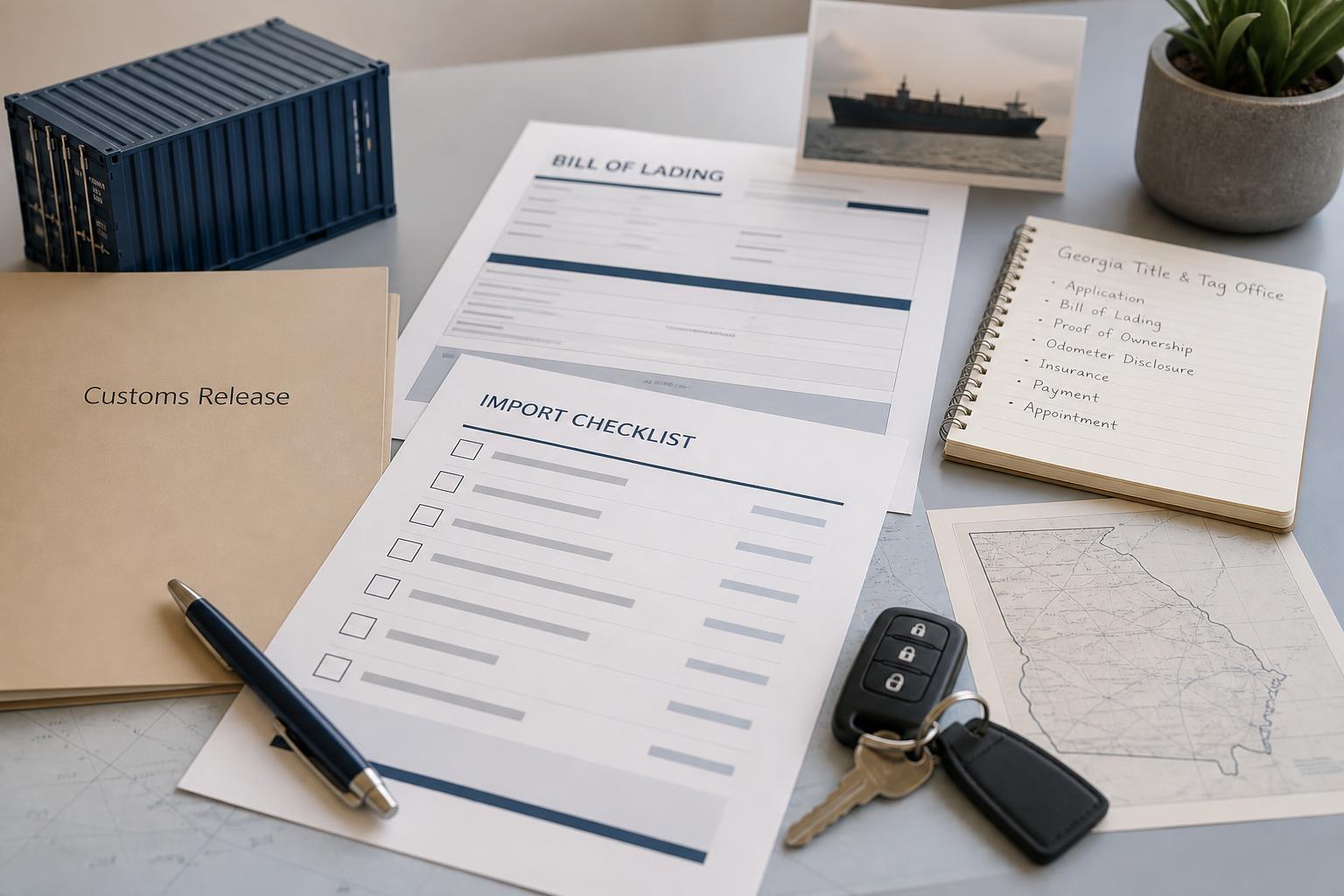
Georgia Department of Revenue says vehicles titled in another state or country can be titled and plated through the owner’s County Tag Office. For a JDM import, the core Georgia packet commonly includes:
- Completed Form MV-1 Title/Tag Application
- Original valid title or foreign registration/export document, properly assigned where applicable
- Out-of-country registration certificate, if applicable
- Completed Form T-22B Certification of Inspection
- Georgia liability insurance on record
- Emission Inspection Certificate, if applicable
- English translation of each non-English document
- Georgia driver’s license or ID
- Payment for title fee, license plate fee, Title Ad Valorem Tax, and any penalties
Georgia also notes that imported vehicles may require original and copy versions of federal import forms such as DOT Form HS-7 and EPA Form 3520-1 when the CBP Form 7501 does not show the vehicle was manufactured for U.S. sale.
For JDM buyers, that means the Customs file is not just for the broker. Save it. The tag office may need pieces of it later.
Form T-22B is a Georgia-specific checkpoint
Georgia requires a Form T-22B Certification of Inspection in the out-of-country title path. This is a visual inspection of the vehicle’s serial plate or VIN information, completed by an authorized Georgia law enforcement officer, county tag agent, or designated employee depending on the situation.
Older JDM vehicles often do not have a 17-digit U.S.-style VIN. They may have a shorter chassis number. That is normal for many Japanese-market vehicles, but the number needs to be consistent across the file.
Before the vehicle ships, compare the chassis number on:
- Japanese export certificate or registration document
- English translation
- Bill of sale and purchase invoice
- Auction sheet or exporter invoice, if available
- Bill of lading
- CBP entry/release documents
- EPA Form 3520-1
- DOT Form HS-7
- Georgia MV-1
- Insurance paperwork
If one document says ECR33-012345, another says ECR33012345, and another only says 012345, the tag office may ask questions. Fixing that after the car lands is like trying to correct a BOL after the vessel sailed. Possible sometimes. Fun never.
English translations should be ready before sailing
Georgia requires English translations for documents not printed in English. For Japan-origin vehicles, this usually means the export certificate or deregistration document needs a clear translation.
The translation should preserve:
- Make
- Model or model code
- Year or manufacture date information shown on the source document
- Chassis number
- Registered owner/exporter information
- Export or deregistration status
- Any lien or ownership notes shown on the document
Do not let the translation “simplify” the vehicle identity. If the chassis number or model code gets dropped, the translation may create the same problem it was supposed to solve.
Metro Atlanta emissions rules are the big Georgia caveat
Georgia emissions rules depend on county, fuel type, GVWR, and model year. Georgia’s Clean Air Force says the emissions program applies to Atlanta’s 13 metro counties: Cherokee, Clayton, Cobb, Coweta, DeKalb, Douglas, Fayette, Forsyth, Fulton, Gwinnett, Henry, Paulding, and Rockdale.
For the 2026 registration period, Georgia’s Clean Air Force lists 2002 through 2023 model-year gasoline-powered cars and light-duty trucks with a GVWR of 8,500 pounds or less as requiring an annual emissions test in those counties. It also lists several exemptions, including antique or collector vehicles 25 model years old or older, which means 2001 and older for the 2026 registration year.
That lines up well for many 25-year-rule JDM imports in 2026, but do not assume. Confirm the current emissions year chart before purchase or shipment if the buyer lives in a metro Atlanta emissions county, the vehicle is close to the cutoff, the fuel type is unclear, or the vehicle classification is unusual.
Also remember: an emissions exemption is not title approval. You still need the Georgia title packet to work.
Hobby Antique plates may help some buyers, but use matters
Georgia offers antique or historic-style plate options for qualifying older vehicles, including vehicles more than 25 years old in certain categories. That can fit some collector JDM imports.
But the plate should match how the vehicle will actually be used. If the buyer plans to daily drive the car, commute, or use it like a normal passenger vehicle, standard registration may be the cleaner route. Antique or hobby plates can come with use expectations, insurance questions, or county handling differences.
Confirm the plate path with the County Tag Office before relying on it to solve emissions, inspection, or registration issues.
Taxes and value support need a clean paper trail
Georgia title work includes taxes and fees, including Title Ad Valorem Tax. A JDM import’s value can be spread across several documents: auction invoice, exporter invoice, bill of sale, ocean freight, inland Japan charges, duty, and broker documents.
Keep the file organized with:
- Purchase invoice or bill of sale
- Auction sheet or exporter invoice, if available
- Payment records, if needed
- Customs entry documents showing declared value
- Bill of lading
- Freight and landed-cost backup, if requested
- English translations for non-English ownership or value documents
Paying Customs duty does not mean Georgia taxes and tag fees are settled. Different counter, different calculator.
Georgia JDM shipping checklist before booking ocean freight
Before the vehicle leaves Japan, Georgia buyers should verify:
- Federal eligibility under the 25-year rule or another lawful import path
- Japanese export certificate or foreign registration document is available
- English translation will be ready
- Bill of sale chain is complete
- Chassis number is consistent across purchase, export, shipping, and Customs documents
- Customs broker will prepare EPA 3520-1, DOT HS-7, CBP entry/release documents, and related import paperwork
- Inland delivery timing is planned after Customs release, not before
- Georgia insurance can be arranged
- County emissions rules have been checked
- T-22B inspection can be completed after arrival
- TAVT, title fee, plate fee, and value support are planned
- Standard vs. antique/hobby plate choice matches the buyer’s actual use
Bottom line for Georgia JDM imports
Georgia can be a solid destination for a federally legal JDM import, but it is document-sensitive. The best time to solve Georgia title issues is before the car is loaded overseas, not after it is sitting stateside waiting for plates.
TGAL can help coordinate the international vehicle shipping plan, including ocean freight timing, arrival planning, and inland delivery after release. For Customs clearance and import-entry help, AWIS covers the broker side: Georgia JDM registration and import clearance planning.
State DMV and county tag office rules can change, and Georgia handling can vary by county, vehicle age, fuel type, GVWR, ownership documents, taxes, insurance, emissions status, and intended use. Confirm current requirements directly with the Georgia Department of Revenue, Georgia’s Clean Air Force, and the buyer’s County Tag Office before purchase, shipment, or registration.
Sources reviewed
- Georgia Department of Revenue: Transfer Title and License Plate from another State or Country
- Georgia Department of Revenue: T-207, How to Obtain a Georgia Certificate of Title for a Vehicle Originating from a Foreign Country
- Georgia’s Clean Air Force: Welcome Motorists
- U.S. Customs and Border Protection: Importing a Motor Vehicle
- NHTSA: Importation and Certification FAQs
Aldo Flores
Founder & CEO, Trans Global Auto Logistics
Licensed NVOCC • FMC Regulated • 30+ Years in International Vehicle Logistics
Aldo Flores is the CEO of Trans Global Auto Logistics, a licensed NVOCC and FMC-regulated freight forwarder based in Arlington, Texas. With 23 years at TGAL and a lifetime in the family business, Aldo has overseen the shipping of more than 100,000 vehicles worldwide — from military PCS moves and classic cars to commercial fleet exports and boat shipments. TGAL was founded by his mother over 25 years ago, and under Aldo's leadership it has grown into one of the most trusted names in overseas vehicle transport.