


Published: October 21, 2026
Colorado is a strong destination for right-hand-drive Japanese imports. Denver, Boulder, Fort Collins, Colorado Springs, Grand Junction, and the broader Front Range enthusiast market have steady demand for Skylines, Land Cruisers, HiAces, Delicas, Chasers, Crowns, Silvias, Pajeros, kei trucks, and kei vans. Military PCS traffic through Buckley Space Force Base, Peterson Space Force Base, the U.S. Air Force Academy, and Fort Carson also drives JDM registration volume. Colorado also has a few quirks that catch first-time importers: title and registration go through the local county Clerk & Recorder rather than a central DMV counter, VIN verification uses a specific state form, and AirCare Colorado emissions testing only applies in certain counties.
Ocean freight, Customs release, inland delivery, Colorado title work, Form DR 2698 VIN verification, AirCare emissions planning in program counties, insurance, and plate choice all need to line up before the vehicle leaves Japan.
CBP release gets the vehicle into the United States. It does not guarantee Colorado title, registration, insurance acceptance, emissions clearance, or plates.
TGAL handles the international vehicle shipping side: Japan/overseas origin coordination, RoRo or container planning when available, ocean freight timing, U.S. arrival planning, and inland delivery after release. For Customs clearance, import entry, CBP paperwork, duty, EPA/DOT documentation, and release planning, AWIS covers the broker side here: Colorado JDM registration and import clearance planning.
Why Colorado registration planning starts before booking ocean freight
Booking a sailing on calendar convenience alone is a common way to create title problems later. The documents created overseas and during transport are often the same documents the county Clerk & Recorder, AirCare, an insurer, or a VIN verifier may need weeks after arrival.
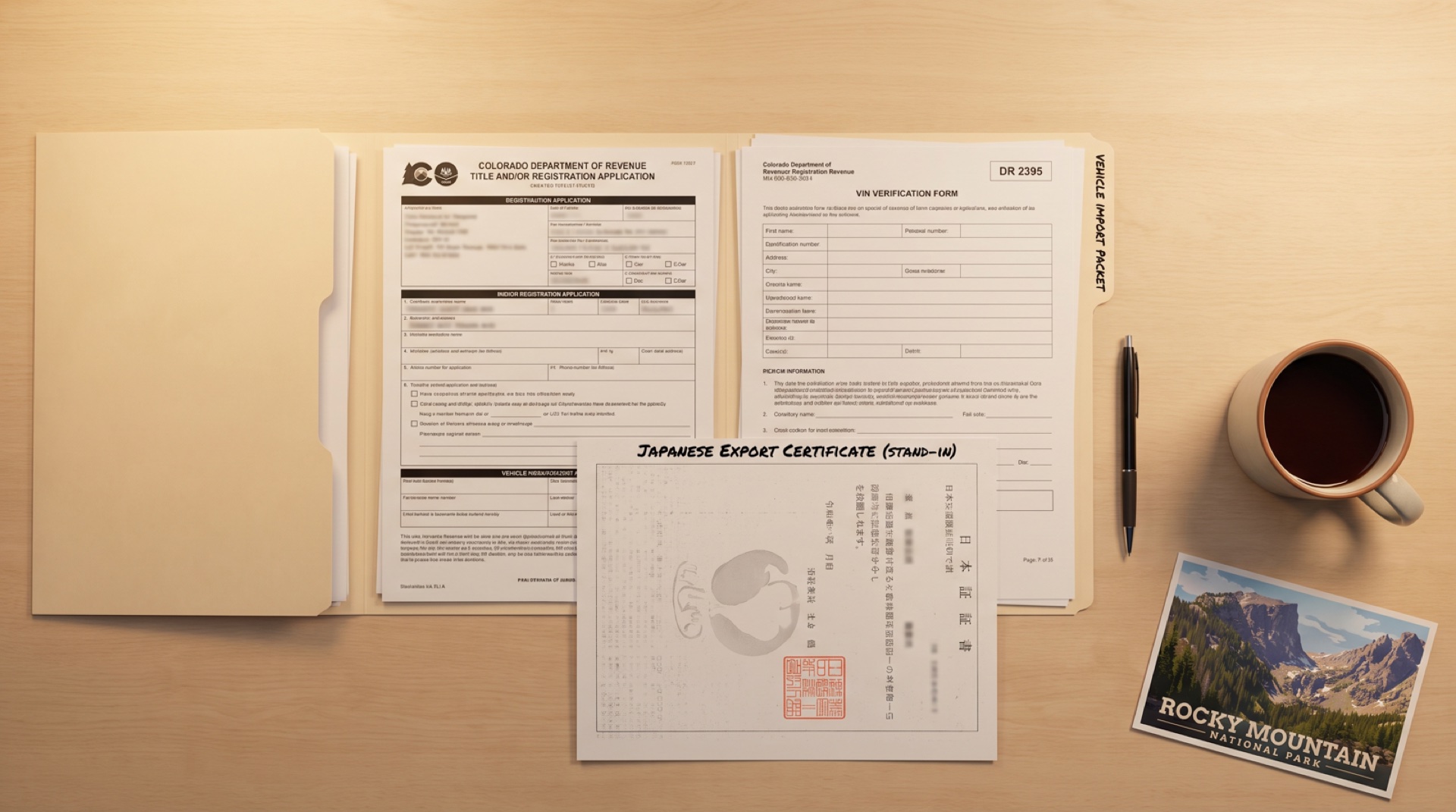
Before the vehicle leaves Japan, confirm:
- The vehicle is federally eligible for import, usually under the 25-year rule for nonconforming JDM vehicles
- The Japanese export certificate, deregistration document, or other foreign ownership document is available
- Foreign-language ownership documents can be translated into English
- The bill of sale shows year, make, model, chassis/VIN, seller, buyer, and purchase price
- The chassis number is readable on the vehicle and consistent across all documents
- The Customs broker will provide CBP Form 7501 and release backup after entry
- DOT Form HS-7 and EPA Form 3520-1 are handled and saved in the file
- Colorado insurance can be issued using the exact Japanese chassis number when there is no 17-digit VIN
- The buyer knows which Colorado county will register the vehicle and whether that county is in the AirCare program
- The plate path matches actual use and actual age: standard registration, collector’s item only where age permits, year-of-manufacture only with a real period-correct Colorado plate, or another eligible path
- Colorado title, specific ownership tax, sales/use tax, registration, VIN verification, plate, and any special-plate fees are budgeted
Fixing a chassis-number mismatch while the car is still with the exporter is annoying. Fixing it after port release, while storage and inland delivery clocks are ticking, is where paperwork becomes a dock fee.
How the shipping-to-registration timeline usually works
A clean Colorado import timeline usually looks like this:
- The buyer confirms federal eligibility and Colorado title/registration/AirCare concerns before purchase or booking.
- The seller/exporter prepares the Japanese export or ownership documents.
- TGAL coordinates the ocean move and U.S. arrival plan.
- The Customs broker prepares the import entry using the bill of lading, invoice or bill of sale, ownership documents, DOT HS-7, EPA paperwork when required, and related records.
- CBP releases the vehicle at the U.S. port.
- Inland transport moves the vehicle to Colorado, storage, an inspection or service location, or the buyer’s selected delivery point.
- The buyer works through Colorado title and registration at the county Clerk & Recorder, Form DR 2698 VIN verification, insurance, AirCare where required, and plate choice.
Do not assume the vehicle can be driven from the port. Customs release is not Colorado registration, insurance, emissions approval, or permission to operate on public roads.
Federal import clearance is not Colorado registration approval
The federal 25-year rule is the import gate. NHTSA allows a motor vehicle at least 25 years old to be imported without regard to whether it meets all applicable Federal Motor Vehicle Safety Standards, using the 25-year basis on DOT Form HS-7. EPA rules separately allow many vehicles at least 21 years old in original configuration to use an EPA import exemption on Form 3520-1. CBP guidance still tells importers to keep the bill of lading, bill of sale, foreign registration, EPA Form 3520-1, DOT Form HS-7, and entry paperwork.
Colorado title and registration are separate state steps. Different gate, same ability to burn a Saturday appointment at the county motor vehicle office.
Colorado titles through the county Clerk & Recorder
Colorado does not have a single central DMV title counter. Title and registration work happens through the county Clerk & Recorder’s motor vehicle division in the county where the vehicle will be registered. That means a Denver County JDM title, a Jefferson County JDM title, and an El Paso County JDM title all share the same state framework but can look slightly different at the counter.
For a first Colorado title after import, the practical file usually includes:
- Completed Form DR 2395, Application for Title and/or Registration
- Original Japanese export certificate, deregistration document, or other foreign ownership document
- Certified English translation for Japanese documents
- Bill of sale and invoice chain from seller/exporter to Colorado applicant
- Bill of lading and arrival documents
- CBP Form 7501 Entry Summary
- DOT Form HS-7 showing the 25-year import basis, or other federal safety exemption support
- EPA Form 3520-1 showing the applicable emissions exemption, or other EPA support
- Any CBP release or duty payment backup available
- Completed Form DR 2698, Verification of Vehicle Identification Number
- Colorado insurance for registration
- AirCare Colorado emissions certificate if the vehicle requires testing in a program county
- Fee payment for title, specific ownership tax, sales/use tax, registration, plates, and any plate-specific charges
The exact packet can vary by model year, fuel type, vehicle class, owner facts, documents, use, and how the county Clerk & Recorder handles the file. Colorado DMV Bulletin BL 17-01 is the state-level reference for imported motor vehicle titling requirements.
Original foreign ownership documents and translations matter
Colorado wants the original title or ownership document to establish ownership. For a JDM vehicle, that usually means the Japanese export certificate, deregistration certificate, or another foreign ownership document that actually proves the ownership history.
Do not treat an auction sheet as the title. Auction sheets are useful backup, but they are not the ownership document Colorado needs to issue a state title.
Colorado county motor vehicle offices generally want foreign-language documents translated into English before they can be used for a title application. For Japanese documents, that translation should be ready before the buyer walks into the county office.
A clean translation should preserve the key vehicle facts: year or first registration date, make and model, body type where shown, chassis number or VIN, engine displacement where shown, owner/exporter details, and odometer or kilometer information.
Many JDM vehicles do not have a 17-digit U.S.-style VIN. They use chassis numbers such as BNR32-012345, JZX100-0000000, KZH106-0000000, or JA11-123456. Before the vehicle ships, compare the chassis number across the export certificate, translation, bill of sale, exporter invoice, bill of lading, CBP Form 7501, DOT HS-7, EPA 3520-1, Colorado Form DR 2395, Form DR 2698 VIN verification, and insurance documents.
Hyphens, zeros, prefixes, and model codes matter. A clerk at the Jefferson County office should not have to become a Nissan historian to figure out whether two documents describe the same car.
Form DR 2698 VIN verification has a chassis-number trap
Colorado requires VIN verification on Form DR 2698 for vehicles previously titled outside Colorado, including vehicles titled outside the United States. The verification is a physical examination that confirms the VIN or chassis number on the vehicle matches the ownership documents.
The DR 2698 can be completed by Colorado law enforcement, a licensed Colorado motor vehicle dealer, or a Colorado emissions testing station. Not every emissions station handles out-of-country VIN verifications in practice, so buyers should call ahead.
For JDM imports, this is really a chassis-number verification. The vehicle may not have a U.S.-style 17-digit VIN, so the buyer should make the number easy to find and easy to match.
Before the verification, confirm:
- Where the chassis number appears on the vehicle
- Whether the chassis plate is readable and attached
- Whether the stamped number matches the Japanese ownership document
- Whether the translation preserved the same number format
- Whether CBP 7501, HS-7, EPA 3520-1, insurance, Form DR 2395, and Form DR 2698 all use the same format
That is the common Colorado trip point for JDM imports. A VIN inspector who has only ever seen U.S.-market 17-digit VINs may hesitate on a short Japanese chassis number. Making the paperwork match the plate on the vehicle removes the argument.
AirCare Colorado emissions depends on the county of registration
Colorado emissions testing is not statewide. AirCare Colorado currently covers Boulder, Broomfield, Denver, Douglas, Jefferson, and portions of Adams, Arapahoe, Larimer, and Weld counties. Vehicles registered outside those program areas are generally not subject to AirCare testing.
Inside the program area, the current rules for gasoline vehicles work roughly like this:
- 1982 model year and newer gasoline vehicles are tested every other year
- 1981 model year and older gasoline vehicles are tested annually
- Hybrid vehicles 8 model years and older generally receive an OBD test
- Diesel vehicles are not tested by AirCare and are handled through other channels
That creates very different outcomes for a 25-year-old JDM vehicle depending on county. A 2001 federally eligible JDM import registered in Denver, Boulder, Douglas, Broomfield, or Jefferson County will generally be in the AirCare program and need a passing emissions test as part of first-time registration. The same vehicle registered in a non-program county is outside AirCare.
Right-hand drive is not the emissions problem. A non-U.S.-market OBD or emissions configuration in an AirCare testing area can be. Some stations handle RHD and non-U.S.-market vehicles cleanly; others will try to steer the vehicle onto equipment that was not designed for it. Call the station in advance and confirm they handle imported RHD vehicles before scheduling the test.
Collector’s item plates — a 2001-era JDM import does not qualify yet
Colorado’s collector’s item plate rules are age-sensitive. The current categories under Colorado’s gas vehicle guidance work roughly like this:
- Model year 1975 and older can be registered as collector’s item with no emissions requirement and no mileage limit
- Model year 1976 through 1993 can be registered as collector’s item exempt from emissions only if the vehicle was first registered as a collector’s item before September 1, 2009, with continuous collector registration
- Vehicles at least 32 years old can be registered as collector’s item, but with an initial emissions test and emissions testing every 5 years, and a 4,500-mile-per-year use limit
For 2026 registrations, that 32-year threshold means model year 1994 and older vehicles.
A 2001 federally eligible JDM import is old enough for the federal 25-year DOT rule and old enough for the EPA 21-year exemption. It is not old enough for Colorado collector’s item plates. The practical result is that a 2001 Skyline GT-R, 2001 R34 Stagea, 2001 Civic Type R, 2001 Delica, or similar vehicle imported into Colorado in 2026 will generally need standard registration and full AirCare emissions in program counties until the vehicle hits 32 years old.
Colorado also offers year-of-manufacture (YOM), horseless carriage, and depot plate paths. YOM plates can be used only when the owner has a legitimate period-correct original Colorado plate from the vehicle’s year of manufacture — not a reproduction and not a plate from another state. That is a very narrow path for a JDM import.
Pick the plate path based on the actual use and the actual age of the vehicle. Collector plates are not a daily-driver shortcut.
Insurance has to accept the Japanese chassis number
Colorado registration generally requires the vehicle to carry Colorado auto insurance meeting state financial responsibility requirements. For a JDM import, the practical issue is often whether the insurance carrier can bind coverage using the Japanese chassis number.
Before the Colorado application goes in, confirm:
- The insurer can cover the specific imported vehicle
- The policy can use a non-17-digit chassis number if there is no U.S.-style VIN
- The year, make, model, body type, and chassis number match the title file
- The policy fits the intended use, especially if standard registration is used instead of a collector path
- The insurance card does not change the chassis format in a way that conflicts with DR 2395 or DR 2698
Insurance formatting mistakes are boring. They are also exactly the kind of boring thing that bounces a title packet back from the county counter.
Odometer and kilometer readings should be clean
Many JDM imports have odometers in kilometers. Colorado title work can involve odometer disclosure depending on model year and transaction facts.
Keep the original reading clear. If a document shows kilometers, say kilometers. If a buyer record includes a mile conversion, label it as a conversion. Do not casually convert kilometers to miles on one document and leave kilometers in another without explaining what happened.
A clean file should show the original reading as displayed, whether that reading is kilometers or miles, any conversion used for buyer records, and whether an odometer disclosure exemption applies based on age.
If the bill of sale says miles, the export certificate says kilometers, and the DR 2395 says something else, the delay is predictable.
Taxes and fees are separate from Customs duty
Customs duty at the port is not Colorado title and registration cost. Colorado assesses state sales or use tax, specific ownership tax (SOT), county and local taxes, title fees, registration fees, plate fees, and VIN verification fees separately.
Specific ownership tax is a Colorado-specific annual tax on motor vehicles based on vehicle age and taxable value. For most new vehicles, Colorado starts from the manufacturer’s suggested retail price. A JDM import does not have a Colorado MSRP, so county motor vehicle offices typically value the vehicle from the buyer’s purchase documents and import paperwork. That makes clean value backup important.
Keep value support ready: purchase invoice, bill of sale, auction invoice or auction sheet if available, exporter invoice, payment proof, CBP entry value, freight and landed-cost backup, and an English translation for any value document written only in Japanese.
Customs duty and Colorado fees are different buckets. Same wallet, different government window.
Kei trucks, vans, and small JDM vehicles need extra checking
Colorado does not have one simple kei rule that fits every case. A kei truck, kei van, or kei car still needs the same title foundation: federal eligibility, CBP entry proof, original ownership documents, translations, Form DR 2395, Form DR 2698 VIN verification, insurance, AirCare handling where relevant, and a plate path that matches real road use and real age.
Before shipping a kei vehicle to Colorado, confirm:
- The vehicle is federally eligible before purchase
- The chassis number is consistent across all documents
- The export certificate and bill of sale describe the vehicle clearly
- Insurance will cover the vehicle for the intended use
- Any off-road-only, farm-use, or limited-use assumption has been confirmed with the Colorado county Clerk & Recorder, not just forum advice
- AirCare requirements have been checked if the vehicle will be registered in a program county
- Collector plates have not been assumed on a vehicle that is not yet 32 years old
Kei vehicles are where internet advice gets expensive. The county Clerk & Recorder’s current handling matters more than a forum post from someone who titled a different truck five years ago.
Practical Colorado checklist before the vehicle ships
Before booking ocean transport to Colorado, confirm:
- Federal import eligibility and EPA/DOT exemption basis
- Japanese export or ownership document availability
- English translations
- Bill of sale and ownership chain
- Chassis-number consistency across every document
- Customs broker plan and CBP Form 7501 availability after entry
- Colorado Form DR 2395 title/registration packet expectations
- Form DR 2698 VIN verification plan with a station or inspector that handles out-of-country vehicles
- Colorado insurance using the Japanese chassis number where needed
- AirCare plan if the buyer is in Boulder, Broomfield, Denver, Douglas, Jefferson, or the covered portions of Adams, Arapahoe, Larimer, or Weld counties
- Plate path based on real use and real age — standard registration is the expected result for a 2001-era JDM import
- Title, specific ownership tax, sales/use tax, registration, VIN verification, plate, and any special-plate fee budget
- Inland delivery timing after Customs release
Bottom line
Colorado can work for a 25-year-old JDM import, but it is detail-sensitive and county-sensitive. The big issues are original foreign ownership documents, certified English translations, CBP Form 7501, DOT HS-7, EPA 3520-1, Form DR 2395, Form DR 2698 VIN verification, insurance that will take a Japanese chassis number, AirCare planning in program counties, and an honest plate decision that respects Colorado’s 32-year collector threshold.
TGAL can help plan the shipping side so the ocean move, Customs release, and inland transport do not fight the Colorado registration timeline. AWIS can help with Customs clearance and import-entry planning. The buyer still needs to confirm title, registration, VIN verification, insurance, emissions, tax, and plate requirements directly with the Colorado county Clerk & Recorder, AirCare Colorado where relevant, and the insurer before purchase or shipment.
This article is general information, not legal advice. Colorado DMV handling, county Clerk & Recorder practices, AirCare, insurance, tax, VIN verification, and plate rules can change, and handling can depend on model year, fuel type, vehicle classification, ownership documents, county of registration, facility, insurance carrier, and intended use. Confirm current requirements with state/county authorities before booking transport or making purchase decisions.
Sources reviewed
- Colorado DMV, titling and registration guidance via county Clerk & Recorder
- Colorado DMV, Form DR 2395 Application for Title and/or Registration
- Colorado DMV, Form DR 2698 Verification of Vehicle Identification Number
- Colorado DMV Bulletin BL 17-01, imported motor vehicle titling requirements
- Colorado DMV, Gas Vehicles / collector’s item plate guidance
- Colorado DMV, horseless carriage, year-of-manufacture, and depot plate information
- AirCare Colorado, program counties and testing requirements
- U.S. Customs and Border Protection, Importing a Motor Vehicle
- NHTSA, DOT Form HS-7 and 25-year import basis
- EPA, Form 3520-1 vehicle import declaration
- AWIS Colorado JDM registration reference post
Aldo Flores
Founder & CEO, Trans Global Auto Logistics
Licensed NVOCC • FMC Regulated • 30+ Years in International Vehicle Logistics
Aldo Flores is the CEO of Trans Global Auto Logistics, a licensed NVOCC and FMC-regulated freight forwarder based in Arlington, Texas. With 23 years at TGAL and a lifetime in the family business, Aldo has overseen the shipping of more than 100,000 vehicles worldwide — from military PCS moves and classic cars to commercial fleet exports and boat shipments. TGAL was founded by his mother over 25 years ago, and under Aldo's leadership it has grown into one of the most trusted names in overseas vehicle transport.


