Published: July 17, 2026
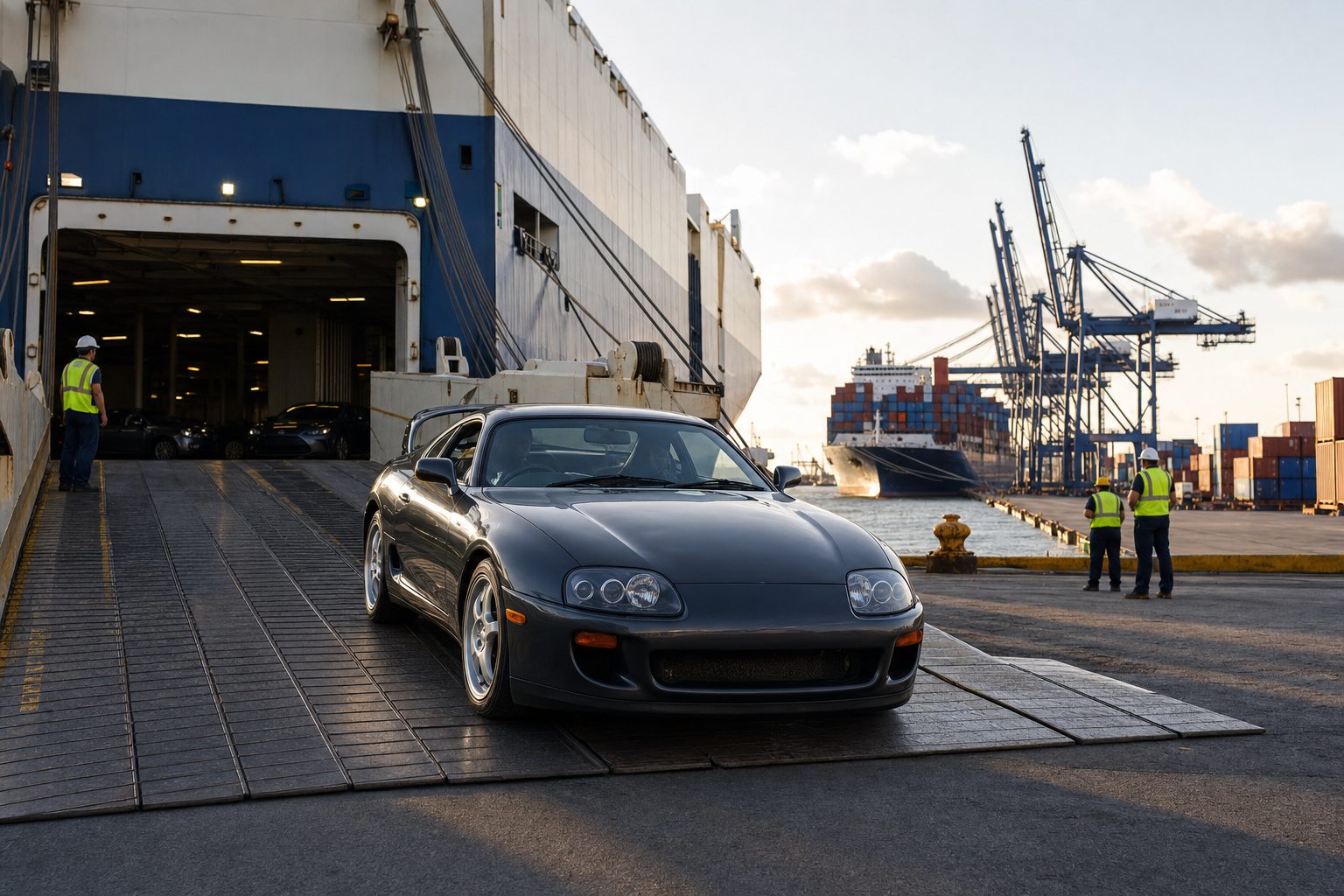
Texas is a practical destination for many 25-year-old JDM imports. It has Gulf ports, a large enthusiast market, military moves, and plenty of buyers bringing in Skylines, Land Cruisers, Delicas, kei trucks, and other right-hand-drive vehicles.
But Texas is not a “ship it first, figure out plates later” state.
A JDM vehicle can be properly booked on ocean freight, released by Customs, delivered inland, and still get stuck before Texas title if the import packet, VIN inspection, insurance, inspection, tax, or county paperwork is not ready. The best time to solve that is before the car leaves Japan or another overseas origin.
Plan the Texas title path before booking ocean transport
Most buyers focus first on the vessel schedule: origin port, sailing date, destination port, roll-on/roll-off or container service, and inland delivery after release.
That matters. But for a Texas-bound JDM vehicle, the state paperwork path should be checked at the same time.
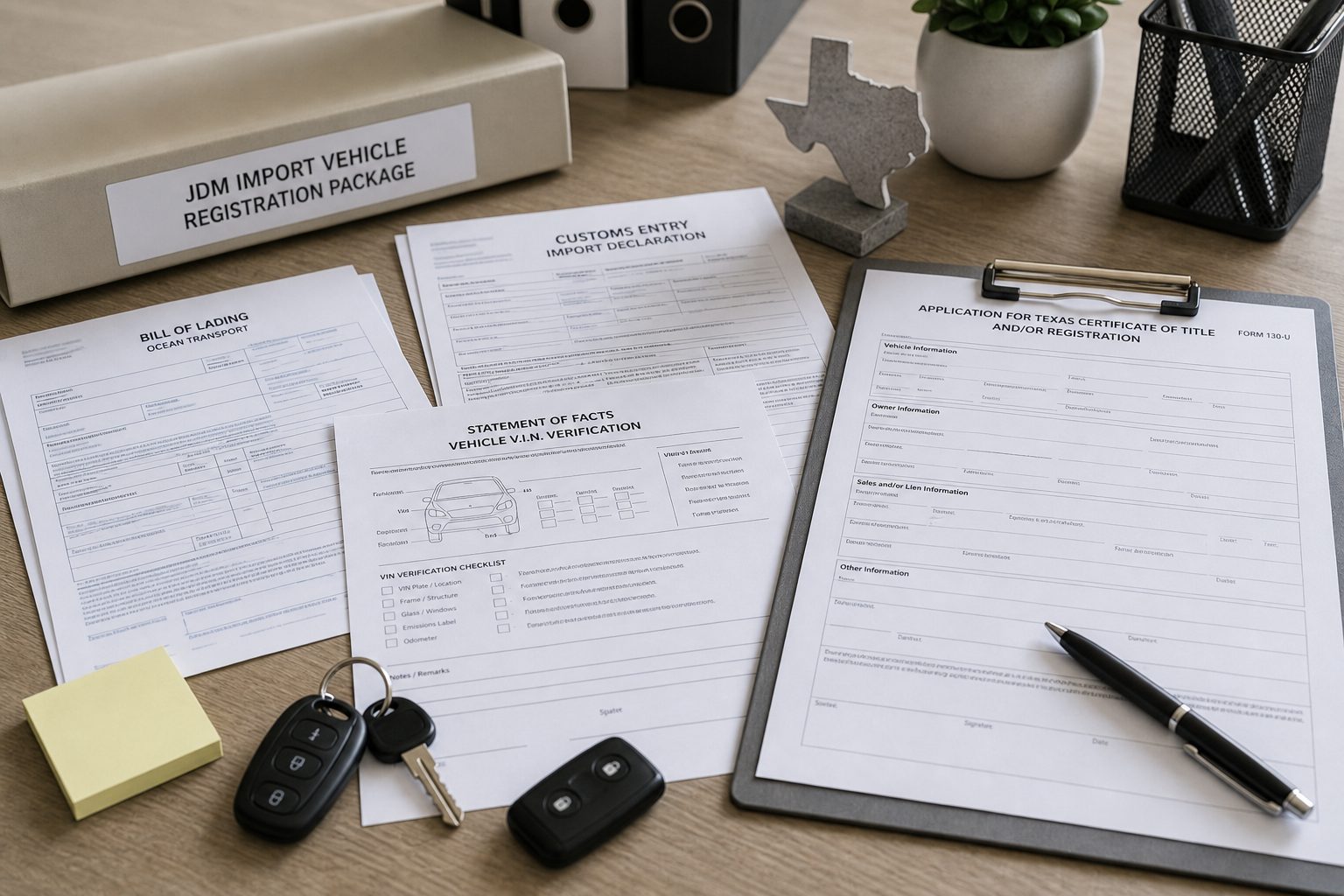
Before booking ocean transport, confirm:
- The vehicle is federally eligible to enter the United States
- The Japanese export certificate or foreign ownership document is available
- A certified English translation can be prepared if the ownership document is not in English
- The VIN or chassis number is written the same way on the export paperwork, invoice, bill of lading, Customs entry, DOT paperwork, and Texas title packet
- The Customs broker will provide the release and entry documents needed for Texas title work
- The buyer knows which Texas county tax office will handle the title and registration
- The VTR-68-A law-enforcement VIN inspection can be scheduled after the vehicle arrives
- The buyer has checked emissions county rules before assuming the vehicle can be registered without extra steps
The ocean move, Customs release, inland transport, and county title visit are connected. Treating them as separate jobs is how a clean shipment turns into a very expensive driveway ornament.
Customs release is not Texas registration approval
Customs release means the vehicle has cleared the federal import process. Texas title and registration is a separate state process.
TxDMV says an imported vehicle must meet federal and state importation requirements before it can be titled or registered in Texas. After Customs release, Texas points owners through any applicable inspection, the imported-vehicle VIN inspection, and the county tax office packet.
For a 25-year-old JDM import, the buyer should expect Texas to care about the same details that matter during shipping: ownership chain, Customs paperwork, DOT import documentation, chassis number consistency, translations, insurance, tax, and county processing.
That handoff is where timing gets tight.
If the car lands at the port and inland transport is already lined up, the buyer may have the vehicle physically delivered before the VTR-68-A inspection or county title packet is ready. That is not a shipping failure. It is a planning failure.
Build the Texas packet while the vehicle is still overseas or on the water
For a Texas-bound JDM vehicle, gather the state title documents before arrival whenever possible.
Common items to plan for include:
- Japanese export certificate or other foreign ownership document
- Certified English translation for any ownership document not printed in English
- Purchase invoice or bill of sale
- Ocean bill of lading or arrival notice
- CBP Form 7501 Entry Summary showing the vehicle information
- DOT Form HS-7, or other document showing Customs entry/clearance and federal safety compliance or exemption
- EPA Form 3520-1, when included in the import file
- Bond release letter if the vehicle was imported under bond
- Vehicle Inspection Report if an applicable inspection is required
- Law Enforcement Identification Number Inspection, Form VTR-68-A
- Completed Application for Texas Title and/or Registration, Form 130-U
- Odometer reading if required
- Proof of Texas insurance
- Sales/use tax and county title/registration fee items
TxDMV specifically calls for the HS-7 or equivalent Customs/federal safety documentation, bond release letter when applicable, VTR-68-A, Form 130-U, odometer information when required, proof of insurance, and certified English translation for non-English ownership documents.
That is why the shipping file and title file should be built together. If the bill of lading says one chassis format and the export certificate says another, the problem may not show up until the county tax office reviews the packet.
The VTR-68-A VIN inspection affects delivery timing
Texas requires an imported vehicle to receive a VIN inspection from a trained auto theft investigator who is a Texas law enforcement officer or part of a Texas political subdivision. TxDMV also says an authorized National Insurance Crime Bureau employee may perform the inspection.
After the inspection, the owner receives the original Law Enforcement Identification Number Inspection, Form VTR-68-A.
This is a major Texas planning item for JDM vehicles because many Japanese-market cars do not have a U.S.-style 17-digit VIN. They may have a shorter chassis number, and the stamping may be in a location the inspector does not see every day.
Before inland delivery, decide where the vehicle will be stored and where the VIN inspection can be handled. If the car goes straight to the buyer’s home, the buyer needs a local plan. If it goes to a shop, dealer, or storage facility, the inspection plan may be different.
Small document mismatches matter here. BNR34, BNR-34, and BNR 34 may look close to a buyer. They may not look close to the person processing the title packet.
Texas inspection and emissions rules depend on county and vehicle details
Texas has changed inspection rules in recent years, but JDM buyers should not treat that as a free pass.
TxDMV still tells imported-vehicle owners to obtain a passing applicable vehicle inspection before registration. Texas DPS also says imported vehicles need the safety and emissions components for that model year installed and operational, and it flags emissions equipment and lighting equipment as common problem areas.
For emissions, Texas DPS lists the affected counties as Brazoria, Collin, Dallas, Denton, El Paso, Ellis, Fort Bend, Galveston, Harris, Johnson, Kaufman, Montgomery, Parker, Rockwall, Tarrant, Travis, and Williamson. DPS says Bexar County becomes an emissions county on November 1, 2026.
DPS guidance says gasoline-powered vehicles from 2 through 24 years old registered in emissions counties receive the OBDII emissions test. Many 25-year-old JDM imports may be outside that 2-through-24-year range, but model year, registration county, fuel type, and classification can change the answer.
Check the correct county before purchase and before booking transport. DFW, Houston, Austin, El Paso, and San Antonio-area buyers especially need to pay attention because a county line can change the practical registration path.
Antique plates may help some Texas owners, but they are not daily-driver plates
Texas antique registration can be useful for some 25-year-old imports. Texas DPS says vehicles registered as antiques are exempt from annual inspection.
That does not make antique plates the right path for every JDM buyer.
Antique registration comes with use limits. It is generally meant for exhibition, club activities, parades, and similar limited use, not normal commuting or daily transportation. If the buyer plans to drive the vehicle regularly, standard registration may be the more appropriate route even if it brings more paperwork.
Do not choose a plate type just because it looks easier on paper. Choose the registration path that matches how the vehicle will actually be used.
Tax and county processing should be part of the import budget
Texas motor vehicle tax is handled through the county tax assessor-collector. The Texas Comptroller lists motor vehicle sales tax at 6.25 percent of the sales price, with separate rules for use tax, new residents, private-party purchases, and standard presumptive value.
For imported vehicles, the county office may look closely at the foreign purchase documents, bill of sale, Customs value, and ownership chain. If the paperwork does not tell a clean story, tax and title processing can slow down.
This belongs in the import budget with ocean freight, port charges, Customs entry, duty, inland transport, storage, inspection, insurance, and title fees. The shipping quote gets the vehicle moving. It does not make the Texas counter disappear. Shame, because that would be a popular add-on.
How shipping, Customs, inland transport, and Texas DMV timing fit together
A clean Texas JDM shipment should be planned in this order:
- Confirm federal import eligibility and Texas title/registration requirements before purchase or booking.
- Gather the export certificate, invoice, ownership chain, and translation requirements before the vehicle leaves Japan.
- Book ocean transport with the final Texas destination and inland timing in mind.
- Coordinate Customs entry so the CBP, DOT, EPA, bill of lading, and ownership details match.
- After Customs release, route inland delivery to the buyer, dealer, shop, or storage location that supports the inspection plan.
- Complete any applicable Texas inspection and the VTR-68-A VIN inspection.
- Bring the full packet, insurance, tax items, and Form 130-U to the county tax office.
The mistake is waiting for the car to arrive before starting state planning. By then, storage charges, transport timing, and inspection availability can all start working against the buyer.
When to involve AWIS for the import-entry side
TGAL handles the international vehicle shipping side: origin coordination, ocean freight planning, destination routing, and inland delivery timing.
For Customs clearance and import-entry help, involve a customs broker before the vehicle ships. AWIS has a Texas JDM registration guide focused on the Customs-to-DMV handoff here: https://awis.us/jdm-registration-texas-imported-vehicles/
That handoff matters because Texas title work often depends on the Customs packet. If the CBP Form 7501, HS-7, ownership document, translation, and chassis number do not line up, the delay may not appear until after the vehicle is already in Texas.
Texas-specific caveat
Texas is usually workable for 25-year-old JDM imports, but the VTR-68-A inspection is the state-specific item buyers should plan early. It is not a casual VIN check, and it can affect where the car should be delivered after Customs release.
Emissions county rules are the second caveat. A buyer in Tarrant, Dallas, Harris, Travis, Williamson, El Paso, or another emissions county should confirm the current requirement before assuming the vehicle can be registered without an emissions-related issue.
Bottom line
If your JDM vehicle is headed to Texas, plan the registration file before booking ocean transport.
The move has four connected stages: overseas export, ocean freight, Customs release, and Texas title/registration. If the import file and Texas packet are built together, the car has a much better chance of moving from port release to plates without a long delay.
TGAL can help plan the international shipping and delivery side so the vehicle’s arrival timing matches the Customs, inspection, inland transport, and Texas county title process.
Ready to ship a JDM vehicle to Texas? Contact TGAL before booking so the ocean freight, Customs release, inland transport, and registration timing are planned together.
Sources reviewed
- Texas Department of Motor Vehicles, Out of State and Imported Vehicles: https://www.txdmv.gov/motorists/buying-or-selling-a-vehicle/out-of-state-and-foreign-vehicles
- Texas Department of Public Safety, Inspection Criteria for Emission Inspection: https://www.dps.texas.gov/section/vehicle-inspection/inspection-criteria-emission-inspection
- Texas Department of Public Safety, Unique Vehicles: https://www.dps.texas.gov/section/vehicle-inspection/unique-vehicles
- Texas Comptroller, Motor Vehicle Sales and Use Tax: https://comptroller.texas.gov/taxes/motor-vehicle/sales-use.php
- AWIS Texas JDM registration/import-entry guide: https://awis.us/jdm-registration-texas-imported-vehicles/
This article is general planning information, not legal advice. Texas DMV, DPS, county tax office, inspection, emissions, and title rules can change, and county processing practices may vary. Confirm current requirements directly with TxDMV, Texas DPS, the correct county tax assessor-collector, and a qualified customs or registration professional before purchasing, shipping, titling, or registering an imported vehicle.
Aldo Flores
Founder & CEO, Trans Global Auto Logistics
Licensed NVOCC • FMC Regulated • 30+ Years in International Vehicle Logistics
Aldo Flores is the CEO of Trans Global Auto Logistics, a licensed NVOCC and FMC-regulated freight forwarder based in Arlington, Texas. With 23 years at TGAL and a lifetime in the family business, Aldo has overseen the shipping of more than 100,000 vehicles worldwide — from military PCS moves and classic cars to commercial fleet exports and boat shipments. TGAL was founded by his mother over 25 years ago, and under Aldo's leadership it has grown into one of the most trusted names in overseas vehicle transport.