Last Updated: June 24, 2026 | Originally Published: April 25, 2026
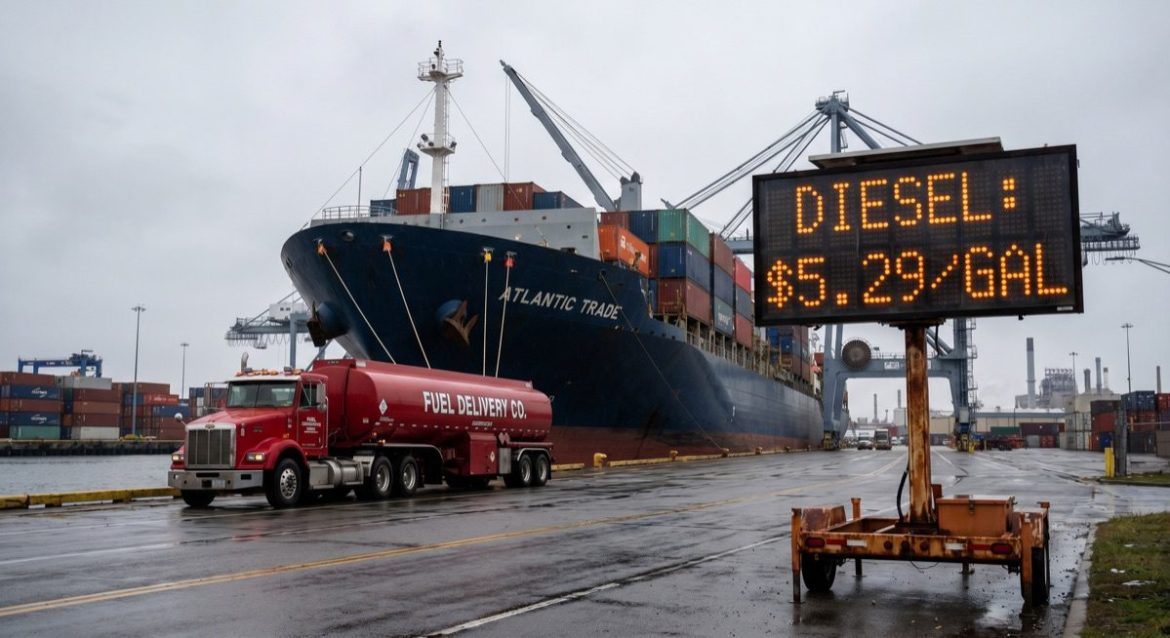
The national average for diesel hit $5.40 per gallon this month. That’s up 57% from a year ago. If you’re shipping a vehicle internationally — whether you’re a military family, a private importer, or a commercial buyer — this number is affecting your bill. Here’s how, and by how much.
Why Diesel Matters for International Shipping
Most people associate diesel prices with truckers. And yes, that’s a big piece of it. But international vehicle shipping involves multiple fuel-dependent legs: port drayage (the trucking to and from the terminal), feeder vessels (smaller ships that consolidate cargo at hub ports), and the ocean carriers themselves, which use bunker fuel priced in close correlation with distillates like diesel.
When diesel prices move 57% in a year, every leg of that chain adjusts — usually with a surcharge.
Ocean Freight: Bunker and BAF Surcharges
Ocean carriers don’t eat fuel cost increases. They pass them through as Bunker Adjustment Factors (BAF) or Fuel Surcharges applied on top of the base freight rate. These are calculated per revenue ton, per vehicle, or as a percentage of base freight — varies by carrier.
Since early 2025, BAF rates on RoRo vessels have climbed roughly 18-24% on major trade lanes. Atlantic routes to Germany and Belgium have seen the sharpest increases because those are longer voyages with more bunker consumption per vehicle slot. Pacific routes (to Guam, Japan, Korea) are not immune but have seen slightly lower surcharge creep due to shorter distances.
For a standard sedan on a transatlantic route, the BAF component alone has added $150-280 to the cost of a shipment compared to 2024 rates.
Port Drayage: The Overlooked Cost
This is the part customers often don’t see itemized. When your vehicle gets picked up from your home and delivered to the port, or picked up at destination and delivered to your home, that’s drayage. It’s local trucking, and it runs on diesel.
Port drayage rates in major US vehicle export hubs — Baltimore, Brunswick (GA), Galveston, Jacksonville — have increased 12-19% over the past year, directly tied to carrier fuel costs. These aren’t surcharges per se; they’re baked into the pickup/delivery quotes carriers give us.
If you’re shipping from Texas to an overseas destination, the Galveston/Houston drayage leg has seen the most movement. We’ve tracked drayage rates from DFW to Galveston go from around $280 in early 2025 to $340+ now for standard vehicles.
Military PCS Shipments: DLA Rates and How This Applies
Military families moving under government orders have their vehicle shipping covered by the Defense Logistics Agency (DLA) rate schedule. The good news: DLA adjusts its carrier payment rates periodically to account for fuel, and military members don’t pay the fuel surcharges directly for their government-covered vehicle.
The catch: TGAL covers one vehicle under GPC-5. If you’re shipping a second vehicle on your own — which is common for families with two cars — you’re paying commercial rates, and those include the full BAF and drayage increases.
For military families shipping a second vehicle, that means budget roughly $200-400 more than you might have paid in 2024 on the same route, depending on destination.
What TGAL Is Doing to Manage Costs
We can’t control fuel prices. What we can do:
Lock rates when we book. Once your vehicle is confirmed with an ocean carrier, the rate is fixed at booking. We don’t go back and add surcharges after the fact. This matters right now because rates are still moving — booking sooner locks you into today’s price, not next month’s.
Multi-carrier relationships. We work with multiple RoRo operators. When one carrier spikes their BAF, we check alternatives. This doesn’t always yield savings, but it often does, especially on less-trafficked routes.
Transparent quotes. Your quote from TGAL shows the base rate and the surcharges separately. You know what you’re paying and why. No surprise invoices at destination.
DLA coordination for military. For service members shipping additional vehicles, we flag available rate options and coordinate with your transportation office to make sure you’re applying any allowable allowances correctly.
When Will Prices Come Down?
Honest answer: hard to say. Diesel prices are tied to global crude, refinery capacity, and geopolitical tension — all of which are messy right now. The Hormuz situation adds pressure on the ocean side (disrupted trade routes increase per-unit fuel consumption). The war in Ukraine, still ongoing, keeps European diesel premiums elevated.
The EIA’s 90-day outlook projects diesel holding in the $4.90-5.50 range through Q3 2026. That’s not relief. If you’re planning a summer PCS — which is peak season for military moves — don’t expect lower rates by June.
Plan for current prices. If they drop, great. Don’t budget for a drop that may not happen.
—
Get a current rate quote for your vehicle shipment:
📞 (817) 354-8313
Or start online: tgal.us/free-international-shipping-quotes/
Rates include all current surcharges. No surprises.
Aldo Flores
Founder & CEO, Trans Global Auto Logistics
Licensed NVOCC • FMC Regulated • 30+ Years in International Vehicle Logistics
Aldo Flores is the CEO of Trans Global Auto Logistics, a licensed NVOCC and FMC-regulated freight forwarder based in Arlington, Texas. With 23 years at TGAL and a lifetime in the family business, Aldo has overseen the shipping of more than 100,000 vehicles worldwide — from military PCS moves and classic cars to commercial fleet exports and boat shipments. TGAL was founded by his mother over 25 years ago, and under Aldo's leadership it has grown into one of the most trusted names in overseas vehicle transport.