Published: September 11, 2026
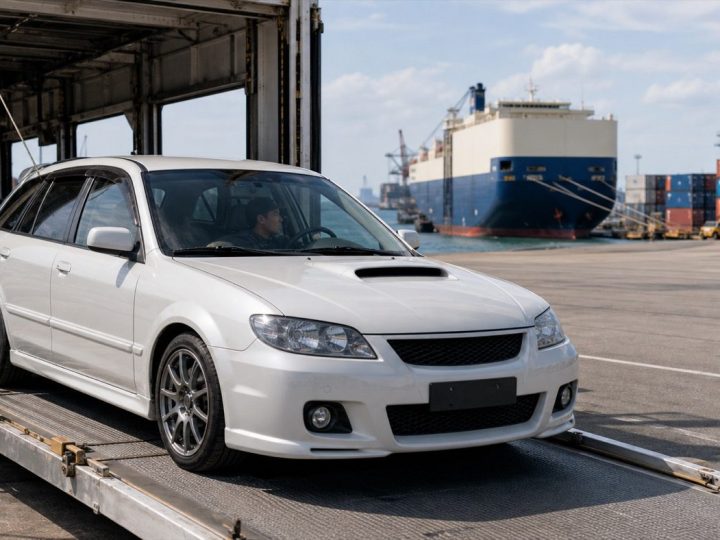
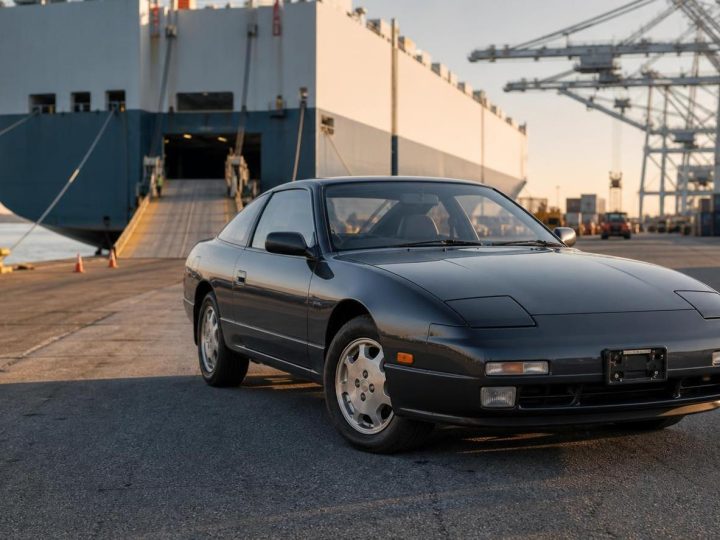
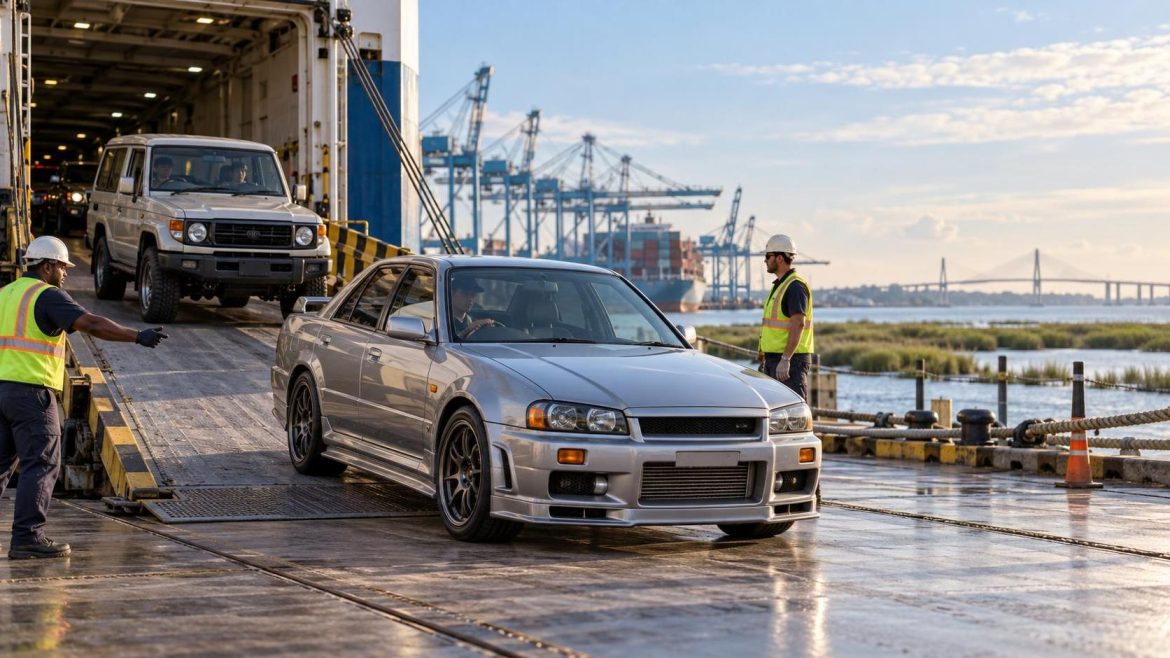
North Carolina can be a practical destination for a 25-year-old JDM import, but the shipping plan and the registration plan need to match from day one. Ocean freight, Customs release, inland delivery, NCDMV title paperwork, insurance, inspection, emissions county rules, taxes, and antique plate choices all connect.
If you are shipping a Skyline, Land Cruiser, HiAce, Delica, Pajero, Crown, Chaser, Silvia, kei truck, or another Japanese-market vehicle from Japan or another overseas origin to North Carolina, do not wait until the vehicle lands to ask whether the state title path works. Customs release gets the vehicle into the country. It does not guarantee a North Carolina title, registration, inspection pass, or plate.
TGAL handles the international vehicle shipping side: overseas pickup coordination, RoRo or container planning when available, ocean freight timing, U.S. arrival planning, and inland delivery after release. For Customs clearance, CBP entry, EPA/DOT paperwork, duty, and import-entry help, AWIS covers the broker side here: North Carolina JDM registration and import clearance planning.
Why North Carolina registration planning starts before booking ocean freight
A North Carolina buyer should not choose a sailing only because the freight rate or vessel schedule looks good. The documents created overseas and during shipment are often the same documents the license plate agency, insurer, inspection station, county tax process, or N.C. State Highway Patrol may ask about later.
Before the vehicle leaves Japan, confirm:

- The vehicle is federally eligible for import, usually under the 25-year rule for nonconforming JDM vehicles
- The Japanese export certificate, deregistration document, or foreign ownership record is available
- Foreign-language ownership documents can be translated into English
- The bill of sale chain connects the seller, exporter, importer, and North Carolina applicant
- The chassis number is readable on the vehicle and consistent across all documents
- The Customs broker will provide usable CBP entry and release documents
- DOT Form HS-7 and EPA paperwork are handled correctly for the import file
- North Carolina insurance can be issued by an acceptable carrier when registration is requested
- The buyer understands the safety inspection path
- Emissions county rules have been checked, even if the vehicle should qualify for an age exemption
- The buyer knows whether standard plates or antique plates fit the intended use
- Highway-use tax, property tax, title fees, registration fees, plate fees, and notary costs are budgeted
This is the part that saves money. Fixing a chassis-number mismatch while the vehicle is still with the exporter is annoying. Fixing it after port release, while storage or inland delivery timing is running, is a paperwork scavenger hunt with a meter attached.
How the shipping-to-registration timeline usually works
A clean North Carolina import timeline usually looks like this:
- The buyer confirms federal eligibility and North Carolina title/registration concerns before purchase or booking.
- The seller/exporter prepares the Japanese export or ownership documents.
- TGAL coordinates the ocean move and U.S. arrival plan.
- The Customs broker prepares the import entry using the bill of lading, invoice or bill of sale, ownership documents, DOT HS-7, EPA paperwork when required, and related documents.
- CBP releases the vehicle at the U.S. port.
- Inland transport moves the vehicle to North Carolina, storage, an inspection location, or the buyer’s chosen delivery point after release.
- The buyer works through NCDMV/license plate agency requirements for title, registration, insurance, inspection, taxes, and plate choice.
Do not assume the vehicle can be driven from the port. Customs release is not North Carolina registration, insurance, inspection, or permission to operate on public roads.
North Carolina title work starts with the NCDMV packet
NCDMV says vehicle title documents depend on the situation, and that additional requirements can apply for vehicle types such as antiques, replicas, mopeds, motorcycles, and trailers. For common title situations, NCDMV lists documents such as the vehicle title, Title Application Form MVR-1, odometer disclosure when required, damage disclosure, and other supporting documents.
For a JDM import, the “vehicle title” is usually not a U.S. title. It may be a Japanese export certificate, deregistration document, or other foreign ownership record, plus an English translation. The license plate agency needs a clean ownership and identity trail, not just auction screenshots and a freight invoice.
A practical North Carolina packet usually includes:
- Japanese export certificate, deregistration document, or foreign registration document
- English translation for foreign-language ownership documents
- Bill of sale and invoice chain showing ownership transfer to the North Carolina applicant
- Bill of lading and arrival documents
- CBP Form 7501 entry summary and any release/entry backup
- DOT Form HS-7
- EPA Form 3520-1 where required or used for the import file
- NCDMV Title Application, Form MVR-1
- Odometer disclosure if required for the vehicle facts
- Damage disclosure if required
- Valid North Carolina driver license, temporary North Carolina driving certificate, or accepted out-of-state driver license if processed at a license plate agency
- North Carolina liability insurance if registration is requested
- Payment support for highway-use tax, property tax, title fee, registration fee, plate fee, and notary fees
For many 25-year-old JDM vehicles, the odometer age rule may not be the main issue. The practical issue is that the original reading is usually in kilometers. Keep the source kilometer reading and mile conversion clear so the title file does not become a math quiz at the counter.
CBP entry proof needs to stay with the DMV file
CBP’s vehicle import guidance points importers to the bill of lading, bill of sale, foreign registration, EPA Form 3520-1, DOT Form HS-7, and entry paperwork. CBP also warns buyers to check EPA and DOT requirements before buying a vehicle overseas.
For North Carolina buyers, that means the Customs packet is not only for port release. It may also be needed later for title and registration support.
Keep:
- CBP Form 7501 entry summary
- CBP release or entry backup where applicable
- Bill of lading
- Bill of sale or purchase invoice
- Foreign registration/export document
- DOT Form HS-7 showing the federal import basis
- EPA Form 3520-1 if part of the entry file
- Duty/payment backup if needed
A broker worksheet or port invoice may be useful, but it is not the same thing as the official CBP entry record. Different document. Different headache.
North Carolina insurance has its own catch
NCDMV says a vehicle with a valid North Carolina registration must have continuous liability insurance from a company licensed to do business in North Carolina. NCDMV also says out-of-state policies are not accepted.
That matters for JDM vehicles because some insurers struggle with non-17-digit Japanese chassis numbers. Before the car ships, ask the insurer whether they can bind coverage using the exact chassis number that appears on the export certificate, Customs entry, and title paperwork.
Collector insurance, storage coverage, or transport coverage may be useful for other parts of the move. But North Carolina registration needs insurance that NCDMV accepts.
Safety inspection is part of the delivery plan
NCDMV says North Carolina-registered motor vehicles must pass annual safety inspection before registration renewal, and the inspection covers items such as headlights, accessory lights, directional signals, foot brake, parking brake, steering, tires, horn, rearview mirror, windshield wipers, exhaust system, and emission control components.
For a JDM import, the common inspection questions are practical:
- Do the lights work correctly for U.S. road use?
- Are the tires acceptable and in safe condition?
- Do the horn, wipers, mirrors, brakes, steering, and exhaust pass inspection?
- Can the inspection station handle a right-hand-drive vehicle with a Japanese chassis number?
- Does the chassis number on the vehicle match the shipping, Customs, insurance, and NCDMV documents?
- Is the vehicle old enough for an inspection exemption, or is the buyer using standard registration?
Right-hand drive alone is not usually the problem. Bad lights, old tires, inconsistent chassis numbers, and missing paperwork are the usual gremlins. Gremlins love storage bills.
Emissions rules depend on county, age, and vehicle type
NCDMV currently lists 19 North Carolina counties where registered motor vehicles must receive an emissions inspection with the annual safety inspection: Alamance, Buncombe, Cabarrus, Cumberland, Davidson, Durham, Forsyth, Franklin, Gaston, Guilford, Iredell, Johnston, Lincoln, Mecklenburg, New Hanover, Randolph, Rowan, Wake, and Union.
NCDMV also lists emissions inspection exemptions for vehicles that are 20 years old or older, diesel-operated vehicles, farm vehicles, and some newer light-duty vehicles that meet age and mileage rules.
That is helpful for many 25-year-old JDM imports. A federally eligible 25-year-old gasoline vehicle should usually be older than North Carolina’s 20-year emissions cutoff. Still, do not treat that as a blanket promise. Confirm current handling with NCDMV, NC DEQ where emissions questions apply, the inspection station, and the registration county before purchase or shipment, especially for kei vehicles, diesel vehicles, swaps, commercial-style vehicles, vans, trucks, or anything with unusual paperwork.
Antique plates are 30-year rules, not the federal 25-year import rule
North Carolina’s antique vehicle rule is separate from the federal 25-year import rule.
NCDMV says antique vehicles are vehicles manufactured at least 30 years ago. Antique plates should be used for vehicles primarily used for exhibitions, club activities, parades, and other public interest events. NCDMV also says antique vehicles must be inspected and photographed by the N.C. State Highway Patrol when presented for first-time titling and registration.
NCDMV’s inspection pages say vehicles more than 30 years old are exempt from annual safety inspection, and vehicles with antique automobile plates are exempt from both annual safety and emissions inspections.
That can be useful for older collector JDM vehicles, but it is not a workaround for every 25-year import. A vehicle can be old enough to enter the United States under federal import rules and still not be old enough for North Carolina antique status.
If the buyer plans to commute, use the vehicle as regular transportation, haul property, or treat it like a daily driver, standard registration may be the cleaner route. Antique plates should match actual collector-style use.
Chassis-number consistency can make or break the handoff
Older Japanese-market vehicles often do not have a 17-digit U.S.-style VIN. They may use a chassis number such as BNR32-012345, KZH106-0000000, JA11-123456, or another manufacturer format.
Before the vehicle ships, compare the identity number across:
- Japanese export certificate or deregistration document
- English translation
- Bill of sale
- Auction invoice or auction sheet, if available
- Bill of lading
- CBP entry and release documents
- DOT Form HS-7
- EPA Form 3520-1 if used
- Insurance documents
- Form MVR-1
- Inspection documents
Keep prefixes, hyphens, zeros, and model codes consistent where possible. If one document says BNR32-012345, another says BNR32012345, and another drops the prefix entirely, the buyer may need to explain the identity trail. Better to fix that before the vehicle is loaded overseas.
If a vehicle has a missing plate, replacement plate, conflicting chassis numbers, or an antique first-time title/registration path, contact NCDMV or the N.C. State Highway Patrol Investigative Services Unit before the vehicle ships or immediately after arrival.
North Carolina taxes and fees are separate from Customs duty
North Carolina generally uses highway-use tax when a title is transferred, and NCDMV notes that vehicle property taxes are collected through the state’s vehicle tax process on behalf of counties. Title fees, registration fees, plate fees, notary fees, and local or regional fees can also apply depending on the transaction.
That is separate from CBP duty.
A JDM buyer may pay Customs duty at the port and still owe North Carolina highway-use tax, county property tax, and DMV fees. Keep clean value support:
- Purchase invoice or bill of sale
- Auction invoice or auction sheet, if available
- Exporter invoice
- Payment proof if available
- CBP entry value
- Bill of lading
- Freight and landed-cost support if requested
- Translation of any value or ownership document written only in Japanese
Port math and DMV math are not the same math. Naturally, both want paperwork.
North Carolina JDM shipping checklist before booking
Before booking ocean freight to move a JDM vehicle toward North Carolina, verify:
- Federal import eligibility under the 25-year rule or another lawful import path
- Original foreign ownership/export document is available
- English translation can be prepared
- Bill of sale chain is complete
- Chassis number is consistent across purchase, export, shipping, Customs, insurance, and title documents
- Customs broker will prepare CBP entry/release documents and coordinate DOT/EPA paperwork
- Inland delivery timing is planned for after CBP release
- North Carolina insurance can be arranged using the vehicle’s chassis number
- Safety inspection path has been checked with a shop or inspection station
- Emissions county rules and age exemptions have been verified
- Standard or antique plate choice matches the buyer’s intended use
- N.C. State Highway Patrol inspection/photo requirements are understood if antique first-time title/registration applies
- Highway-use tax, property tax, title fees, registration fees, inspection costs, and notary fees are budgeted
Bottom line for North Carolina JDM imports
North Carolina is workable for many 25-year-old JDM imports, but it still has state-specific traps. The main ones are North Carolina insurance requirements, annual safety inspection planning, emissions county rules with the 20-year age exemption, highway-use tax and property tax, and antique vehicle rules that start at 30 years instead of 25.
TGAL can help coordinate the international vehicle shipping plan, including ocean freight timing, U.S. arrival planning, and inland delivery after Customs release. For Customs clearance and import-entry help, AWIS covers the broker side: North Carolina JDM registration and import clearance planning.
State DMV rules can change, and North Carolina handling can vary by vehicle age, fuel type, GVWR, county, inspection station, ownership documents, insurance carrier, tax facts, plate type, vehicle classification, and intended use. Confirm current requirements directly with NCDMV, the selected license plate agency, NC DEQ where emissions questions apply, the N.C. State Highway Patrol when needed, the buyer’s insurance provider, and county or local authorities before purchase, shipment, or registration.
Sources reviewed
- NCDMV: Vehicle Documents & Forms
- NCDMV: Vehicle Safety Inspection
- NCDMV: Vehicle Emission Inspection
- NCDMV: Other Vehicle Types to Title and Register
- NCDMV: Vehicle Insurance Requirements
- NCDMV: Vehicle Title & Registration Fees
- U.S. Customs and Border Protection: Importing a Motor Vehicle
- NHTSA: Importation and Certification FAQs
Aldo Flores
Founder & CEO, Trans Global Auto Logistics
Licensed NVOCC • FMC Regulated • 30+ Years in International Vehicle Logistics
Aldo Flores is the CEO of Trans Global Auto Logistics, a licensed NVOCC and FMC-regulated freight forwarder based in Arlington, Texas. With 23 years at TGAL and a lifetime in the family business, Aldo has overseen the shipping of more than 100,000 vehicles worldwide — from military PCS moves and classic cars to commercial fleet exports and boat shipments. TGAL was founded by his mother over 25 years ago, and under Aldo's leadership it has grown into one of the most trusted names in overseas vehicle transport.