Published: July 31, 2026
Virginia is a strong destination for JDM imports. Northern Virginia has a serious enthusiast market, Hampton Roads sees military and port traffic, and buyers around Richmond, Norfolk, Virginia Beach, and the D.C. suburbs regularly look at Skylines, Land Cruisers, Delicas, kei trucks, and other right-hand-drive vehicles.
The state can be workable for a federally legal 25-year-old JDM import, but the paperwork needs to be lined up before the car is loaded overseas.
TGAL handles the international vehicle shipping side: ocean transport, arrival timing, port release coordination, and inland transport after Customs release. For Virginia buyers, the issue is the handoff after arrival. Customs release does not automatically mean Virginia DMV will title, register, plate, and clear the vehicle for road use.
Before booking ocean freight, build the Virginia title and registration plan around the same documents used for shipping and Customs.
Federal import eligibility comes first, but Virginia title work is separate
A JDM vehicle that is at least 25 years old may qualify for the federal NHTSA exemption from current Federal Motor Vehicle Safety Standards. That is the federal import gate. It does not replace Virginia DMV requirements.
Virginia treats imported vehicles as vehicles brought into the U.S. from another country. Virginia DMV says imported vehicles less than 25 years old must provide proof of FMVSS compliance or exemption before Virginia title and registration. Virginia law also says a foreign market vehicle manufactured 25 or more years ago is not subject to that foreign-market-vehicle FMVSS proof section.
That 25-year language helps many JDM buyers. It does not erase the DMV packet.
Virginia still wants a clear ownership chain, official Customs forms, vehicle identity documents, tax payment or exemption support, and a registration path that matches how the vehicle will be used.
If you need help with Customs clearance or import-entry planning, AWIS covers that side here: https://awis.us/jdm-registration-virginia-imported-vehicles/
Build the Virginia packet before the vessel sails
For a Virginia-bound JDM import, do not wait until the car arrives to start collecting title documents. The best time to fix paperwork is before the vehicle leaves Japan. After arrival, the clock tends to come with storage charges attached. Logistics has a sense of humor, and it is usually expensive.
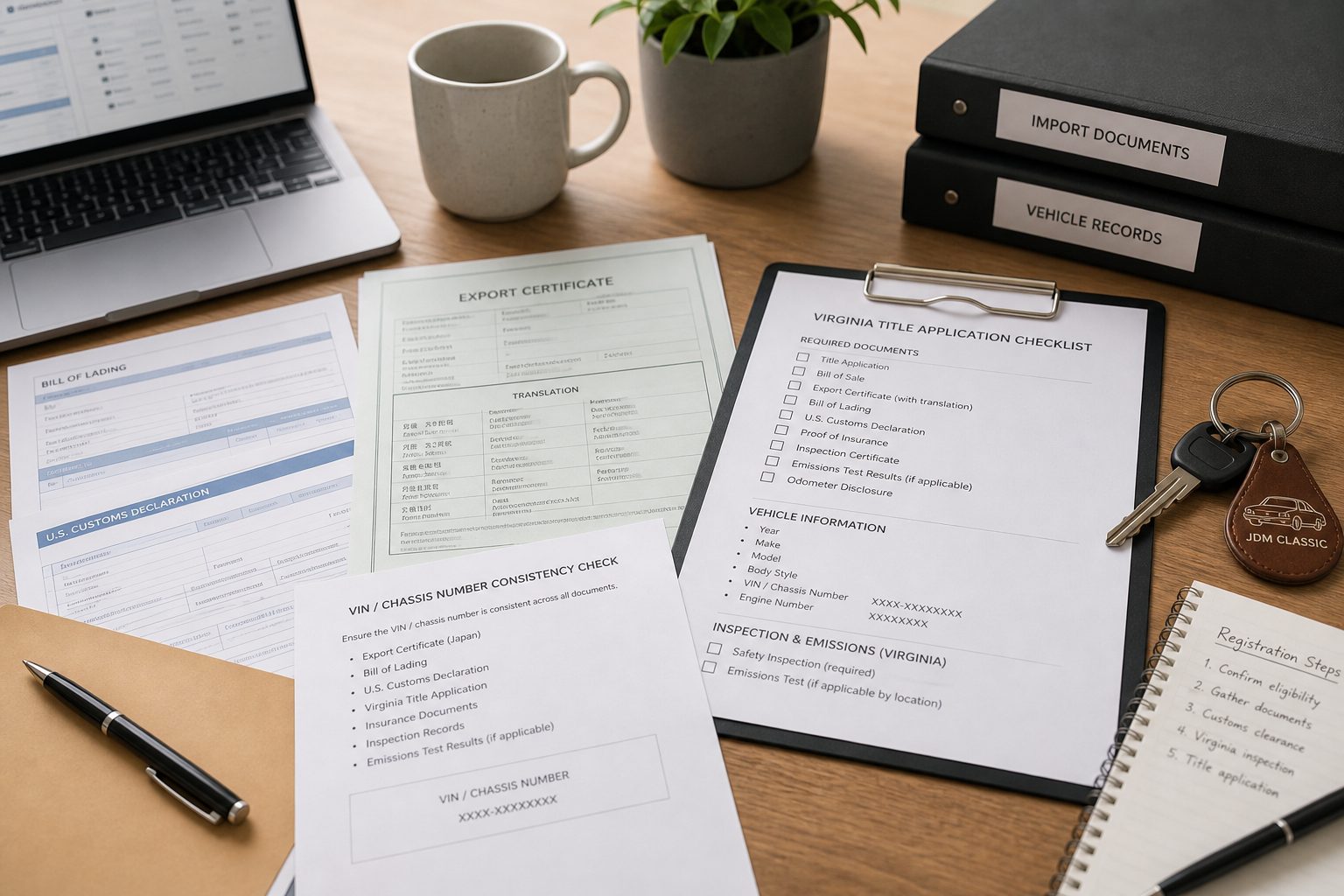
A practical Virginia file should include:
- Completed Virginia Application for Certificate of Title and Registration, VSA 17A
- Proof of Virginia address
- Japanese export certificate or other authentic ownership document
- English translation if the ownership document is not in English
- Bill of sale or purchase invoice showing the vehicle and buyer
- Exporter invoice if the export certificate is assigned to an exporter instead of the Virginia applicant
- Bill of lading or arrival notice
- CBP Form 7501 Entry Summary
- CBP Form 3461
- EPA Form 3520-1, when applicable
- DOT Form HS-7 and any supporting documents required by the import basis
- Value support for Virginia Motor Vehicle Sales and Use Tax
- Insurance documents before registration
- Photos of the chassis number/VIN location on the vehicle
Virginia DMV notes that Customs forms must display the VIN to verify the vehicle being imported. For a JDM vehicle, that may be a Japanese chassis number rather than a U.S.-style 17-digit VIN. That is normal, but it needs to be consistent.
The chassis number needs one clean identity
Many Japanese-market vehicles have shorter chassis numbers. A Skyline, Land Cruiser, Delica, or kei truck may not have a 17-digit VIN. Virginia can still process imported vehicles, but mismatched numbers create avoidable delays.
Before booking ocean transport, compare the chassis number across:
- Japanese export certificate
- English translation
- Purchase invoice or bill of sale
- Auction sheet, if available
- Bill of lading instructions
- CBP Form 7501
- CBP Form 3461
- EPA Form 3520-1
- DOT Form HS-7
- Virginia VSA 17A
- Insurance documents
If one document shows a hyphen, another drops it, and a third uses only part of the frame code, fix that before the car is loaded. A good import can still get slowed down by a tiny formatting mismatch. DMV counters are not built for guessing Japanese chassis codes.
Shipping timing: ocean freight, Customs release, inland delivery, then DMV
The clean sequence for a Virginia JDM import usually looks like this:
- Confirm the vehicle is federally eligible and Virginia registration looks workable before purchase or booking.
- Collect ownership documents, translations, chassis photos, and seller/exporter invoices.
- Book ocean transport after the vehicle identity and import basis are clear.
- Prepare Customs entry documents before the vessel arrives.
- Clear CBP and secure official entry/release documents.
- Release the vehicle from the port, terminal, CFS, or bonded location.
- Arrange inland transport to Virginia, a shop, inspection station, or storage location.
- Complete Virginia title, tax, registration, inspection, insurance, and plate steps.
The weak spot is usually between Customs release and DMV title work. A vehicle can be released from the port and still not be legal to drive in Virginia.
Plan inland transport accordingly. Do not assume the buyer can fly in, grab keys at the port, and drive home on hope and auction-sheet optimism.
Virginia safety inspection matters for normal registration
Virginia has an annual safety inspection program. Virginia State Police says there is no grace period once a vehicle is registered in Virginia, and it recommends having the safety inspection performed before registration when possible.
That matters for JDM imports using standard plates or antique vehicles registered for everyday driving.
Before the vehicle ships, look beyond the auction grade. Safety inspection issues can include:
- Lights and reflectors
- Tires
- Brakes
- Windshield and glass
- Mirrors
- Wipers
- Seat belts
- Exhaust condition
- Steering and suspension
- Modifications that may not pass inspection
This is not a Customs issue. It is a road-use issue. If the car needs repairs before inspection, build that into the shipping and inland delivery plan.
Virginia emissions rules depend on where the vehicle is garaged
Virginia emissions testing applies when a vehicle is garaged in certain Northern Virginia localities:
- Arlington County
- Fairfax County
- Loudoun County
- Prince William County
- Stafford County
- City of Alexandria
- City of Fairfax
- City of Falls Church
- City of Manassas
- City of Manassas Park
Virginia DMV lists an exemption for gasoline-powered passenger or property-carrying vehicles with a model year more than 25 years old before January 1 of the current calendar year. DMV also says vehicles 25 years old or older qualify as antique motor vehicles but do not have to display antique plates to qualify for that emissions exemption.
That is useful for many 25-year-old gasoline JDM imports.
Still, do not treat it as universal. Diesel rules are different. Fuel type, model year, GVWR, locality, registration record, and vehicle classification can change the answer. If the vehicle will be garaged in one of the listed emissions areas, confirm the emissions path before the vehicle leaves Japan.
Antique plates are not daily-driver plates
Virginia’s antique vehicle age threshold lines up well with many JDM imports. Virginia DMV says a passenger vehicle, trailer, semi-trailer, or motorcycle with a model year more than 25 model years old before January 1 of the current calendar year may qualify as antique.
But antique plates come with use restrictions.
Virginia limits show/collector antique plate use to activities such as club events, exhibits, tours, parades, testing, repairs, maintenance, sale activity, transportation to and from those events, and occasional pleasure driving within 250 miles of the owner’s residence. DMV says the vehicle may not be used for general daily transportation, including driving to and from work.
Virginia also requires antique vehicle owners to certify that they own or regularly use another vehicle without antique plates for daily transportation and that the antique vehicle can be driven safely on Virginia highways.
Virginia State Police says vehicles registered as antique are exempt from state inspection. That exemption does not mean unsafe vehicles are acceptable. It means the owner is taking responsibility for the vehicle’s safe operating condition.
If the buyer wants to daily-drive the JDM vehicle, standard plates are usually the cleaner path. Antique plates are for collector use, not a paperwork trapdoor for commuting.
Sales and Use Tax needs value support
Virginia DMV says it collects 4.15% Motor Vehicle Sales and Use Tax at the time of titling when a vehicle is sold or ownership changes. The amount due is based on the vehicle’s gross sales price, or $75, whichever is greater.
For JDM imports, bring support for the value:
- Purchase invoice
- Bill of sale
- Auction sheet, if available
- Export certificate and translation
- Payment records, if needed
- Condition photos
- Repair estimates, if the vehicle needs work
- Customs entry value documents
Virginia lists exemptions in some cases, including a common first-time Virginia titling exemption when the owner already holds a valid title or registration in their name from another state or a branch of the U.S. Armed Forces. If the vehicle was purchased within the last 12 months, DMV says proof that SUT was paid elsewhere is needed for that exemption.
For a fresh Japan purchase, expect tax questions and bring clean value documents.
What Virginia buyers should confirm before booking ocean transport
Before the vehicle is loaded overseas, confirm:
- The vehicle is federally eligible under the 25-year rule or another valid import path
- The Japanese export certificate is available and can be translated
- The ownership chain connects the exporter or seller to the Virginia buyer
- The chassis number is readable on the vehicle
- The same chassis number format will be used on shipping, Customs, and DMV documents
- The bill of lading will show the correct vehicle details
- The Customs broker has the documents needed for entry
- Virginia DMV imported-vehicle requirements are understood before arrival
- Safety inspection repairs are planned if needed
- Emissions status is clear if the vehicle will be garaged in a listed locality
- Standard, antique, or vintage plate use matches how the buyer will actually drive the vehicle
- Sales and Use Tax support is ready
- Inland transport does not assume the car can be driven immediately after Customs release
That last point matters. The vehicle may need to move from the port to Virginia by carrier before it can legally be driven.
Bottom line for Virginia JDM imports
Virginia is usually manageable for 25-year-old JDM imports, but it is document-sensitive. The buyer needs a shipping plan, a Customs plan, and a Virginia DMV plan before the vehicle leaves Japan.
TGAL can help with the international vehicle shipping, ocean freight, arrival coordination, port release timing, and inland transport. For Customs clearance and import-entry help, AWIS can handle that side: https://awis.us/jdm-registration-virginia-imported-vehicles/
For Virginia title, registration, safety inspection, emissions, tax, and plate decisions, confirm requirements directly with Virginia DMV, Virginia State Police, Virginia DEQ where emissions questions apply, and the correct DMV service center before purchase or arrival.
State DMV rules can change, local practices can vary, and requirements may depend on model year, vehicle classification, owner status, fuel type, county/locality, documentation, and intended use. This article is general information, not legal advice. Confirm the current requirements with state and county authorities before buying or shipping the vehicle.
Sources reviewed
- Virginia DMV, Title an Imported Vehicle in Virginia: https://www.dmv.virginia.gov/vehicles/title/imported
- Virginia DMV, Emissions Inspections: https://www.dmv.virginia.gov/vehicles/registration/emissions
- Virginia DMV, Antique Motor Vehicles and Trailers: https://www.dmv.virginia.gov/vehicles/registration/antique
- Virginia DMV, Motor Vehicle Sales and Use Tax: https://www.dmv.virginia.gov/vehicles/taxes-fees/sut
- Code of Virginia § 46.2-602, Titling and registration of foreign market vehicles: https://law.lis.virginia.gov/vacode/title46.2/chapter6/section46.2-602/
- Virginia State Police, Vehicle Inspection FAQs: https://vsp.virginia.gov/safety-and-enforcement/safety-division/vehicle-inspection-faqs/
- U.S. Customs and Border Protection, Importing a Motor Vehicle: https://www.cbp.gov/trade/basic-import-export/importing-car
Aldo Flores
Founder & CEO, Trans Global Auto Logistics
Licensed NVOCC • FMC Regulated • 30+ Years in International Vehicle Logistics
Aldo Flores is the CEO of Trans Global Auto Logistics, a licensed NVOCC and FMC-regulated freight forwarder based in Arlington, Texas. With 23 years at TGAL and a lifetime in the family business, Aldo has overseen the shipping of more than 100,000 vehicles worldwide — from military PCS moves and classic cars to commercial fleet exports and boat shipments. TGAL was founded by his mother over 25 years ago, and under Aldo's leadership it has grown into one of the most trusted names in overseas vehicle transport.