Last Updated: June 24, 2026 | Originally Published: April 8, 2026
If you’re PCSing this summer, you’ve probably heard bits and pieces about changes to the military moving system. Some of it’s accurate. Some of it’s Facebook rumor. Here’s what’s actually happening — and what it means for shipping your vehicle.
Three Changes Hitting at Once
1. The New Personal Property Activity (May 1)
The Pentagon is standing up a permanent agency called the Personal Property Activity at Scott Air Force Base, replacing the old PCS Joint Task Force. It goes live May 1, 2026, and reports directly to the Secretary of Defense.
The new agency already has about 120 people, a joint operations center pulling data from all branches, and a call center staffed by active-duty troops. Their first big problem: the Defense Personal Property System — the software that tracks your household goods shipment — is over 25 years old and close to failing. A replacement is being developed.
For your vehicle shipment, this doesn’t change anything. The Personal Property Activity handles household goods, not POVs. Your vehicle still ships through the GPC-5 contract (for the first POV) and through a commercial carrier like TGAL for the second.
2. HomeSafe Contract Is Dead
The Pentagon terminated the Global Household Goods Contract with HomeSafe Alliance. This was the attempt to put all military household moves under one private contractor. It didn’t work — it created delays, lost shipments, and frustrated families before it fully rolled out.
Military moves are back to the traditional system through your installation’s Personal Property Office. For most families, that’s actually good news — it’s the system you already know.
Again, this affects household goods, not vehicle shipments. Your car, truck, motorcycle, or boat ships separately.
3. Discretionary Moves Cut 50% by 2030
All branches have been directed to cut discretionary PCS move budgets in half by fiscal year 2030:
- FY2027 (Oct 2026): 10% cut
- FY2028: 30% cut
- FY2029: 40% cut
- FY2030: 50% cut
Discretionary moves include career development, education-related moves, and broadening assignments. Operational moves, overseas rotations, and training relocations are not affected.
This summer is not affected. The reductions don’t start until October 2026. This year’s PCS cycle runs under current rules with current volume.
But the long-term implication is real: longer tours mean you’ll need both vehicles at your duty station for a longer stretch. That makes shipping your second vehicle more practical, not less.
The Hormuz Problem: Why Overseas Moves Are Slower Right Now
Here’s the part nobody in the PCS Facebook groups is talking about clearly.
The Strait of Hormuz — through which 20% of the world’s oil flows — has been effectively closed since early March. Transit through the strait dropped 95% year over year. The IRGC formally closed it to allied-nation shipping on March 27.
What that means for PCS vehicle shipments:
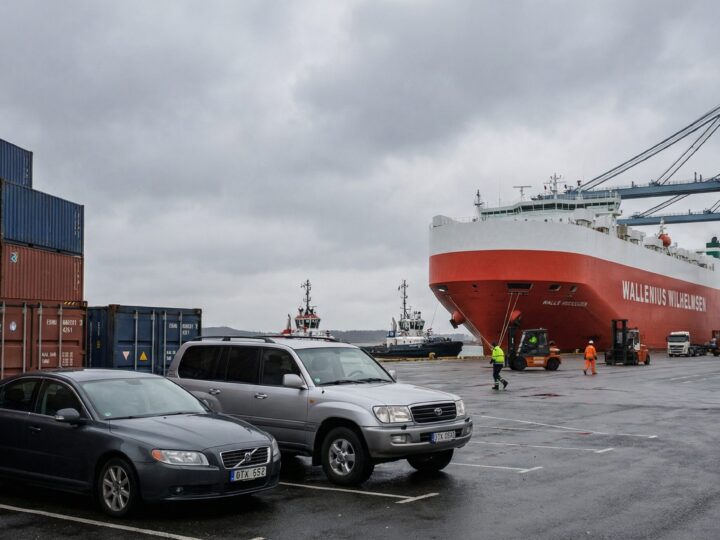
Gulf-region destinations (Bahrain, Kuwait, Qatar, UAE): Vehicle shipping is severely disrupted. Some carriers have suspended service entirely. Others are routing around the Cape of Good Hope, adding 10–14 days and higher fuel costs.
European destinations: Routes that don’t touch the Suez Canal are running normally. Routes through Suez are facing delays as carriers assess Red Sea safety.
Pacific destinations (Japan, Korea, Guam, Hawaii): Not affected by Hormuz. These routes are running on schedule. The only impact is higher fuel surcharges across the board.
Fuel surcharges are up everywhere. Diesel hit $5.62 per gallon nationally as of early April — up from $3.49 in mid-February. Ocean carrier bunker fuel has spiked too. Emergency fuel surcharges are rolling out from every major carrier through April.
2026 PCS Allowances — The Numbers
- Dislocation Allowance (DLA): Up 3.8%. Ranges from $1,018.96 (E-1, no dependents) to $6,385.58 (O-7+, with dependents)
- PPM/DITY reimbursement: Back to 100% of government constructed cost (was temporarily 130% during the 2025 crisis)
- Per diem: $110 lodging + $68 M&IE at most CONUS locations
- POV entitlement: One vehicle per PCS order (OCONUS). Second vehicles ship commercially at your expense.
What to Do Right Now
If you’re PCSing OCONUS this summer:
- Book your first POV through DPS as soon as you have orders
- Contact TGAL immediately for your second vehicle — carrier space fills fast during peak season (May–August)
- If your destination is in the Gulf region, talk to us about current transit times and routing options
- Get your PCS orders to us early — we need them for customs documentation
If you’re PCSing CONUS:
The government doesn’t cover vehicle shipping for stateside moves. You’ll need to arrange transport through a commercial carrier. If TGAL is handling your international second vehicle, our sister company Transcar handles domestic transport.
For everyone:
- Keep detailed vehicle records (VIN, mileage, condition photos) before handing off to any carrier
- Don’t wait until June to book. Summer PCS volume combined with fuel surcharges and carrier shortages means earlier booking = better rates and more carrier availability
- Ask about current fuel surcharges when you get a quote — they change weekly right now
The Bottom Line
The household goods system is in transition. The vehicle shipping system is not. TGAL has been handling military second vehicle shipments for over 20 years through every HHG contract change, every peak season crunch, and every overseas crisis. The process is the same: you call us, we handle the booking, ocean freight, customs clearance, and delivery.
What’s different this year is fuel costs and, for Gulf destinations, transit disruptions. Both are temporary. Both are transparent on your invoice.
Questions? Call (817) 354-8313 or get a free quote.
Sources: Military.com, “3 Big PCS Changes Are Coming at Once,” March 27, 2026. Defense Finance and Accounting Service, 2026 DLA rate tables. U.S. Energy Information Administration, weekly diesel price data. USNI News, Strait of Hormuz transit data, March 2026.
Aldo Flores
Founder & CEO, Trans Global Auto Logistics
Licensed NVOCC • FMC Regulated • 30+ Years in International Vehicle Logistics
Aldo Flores is the CEO of Trans Global Auto Logistics, a licensed NVOCC and FMC-regulated freight forwarder based in Arlington, Texas. With 23 years at TGAL and a lifetime in the family business, Aldo has overseen the shipping of more than 100,000 vehicles worldwide — from military PCS moves and classic cars to commercial fleet exports and boat shipments. TGAL was founded by his mother over 25 years ago, and under Aldo's leadership it has grown into one of the most trusted names in overseas vehicle transport.