

Last Updated: June 24, 2026 | Originally Published: April 8, 2026
The 25-year rule is the legal pathway most enthusiasts use to bring Japanese domestic market vehicles into the United States. The rule is simple. The execution has a few landmines. Here’s how to do it right.
What the 25-Year Rule Actually Says
Federal law — specifically the National Traffic and Motor Vehicle Safety Act — exempts vehicles that are at least 25 years old from Federal Motor Vehicle Safety Standards (FMVSS). The EPA has a parallel exemption for emissions compliance under the Clean Air Act.
Combined, those two exemptions mean a vehicle that’s 25 years old or older can be imported without modification to meet US safety or emissions standards. No crash testing. No emissions equipment retrofit. No DOT-approved headlight conversions (though you’ll still want to sort out driving legality in your state).
In 2026, the cutoff is January 1, 2001 and earlier. Any vehicle with a manufacturer date on or before that date is eligible.
What Becomes Eligible in 2026
Some notable vehicles that crossed the 25-year threshold in 2026 or are crossing it this year:
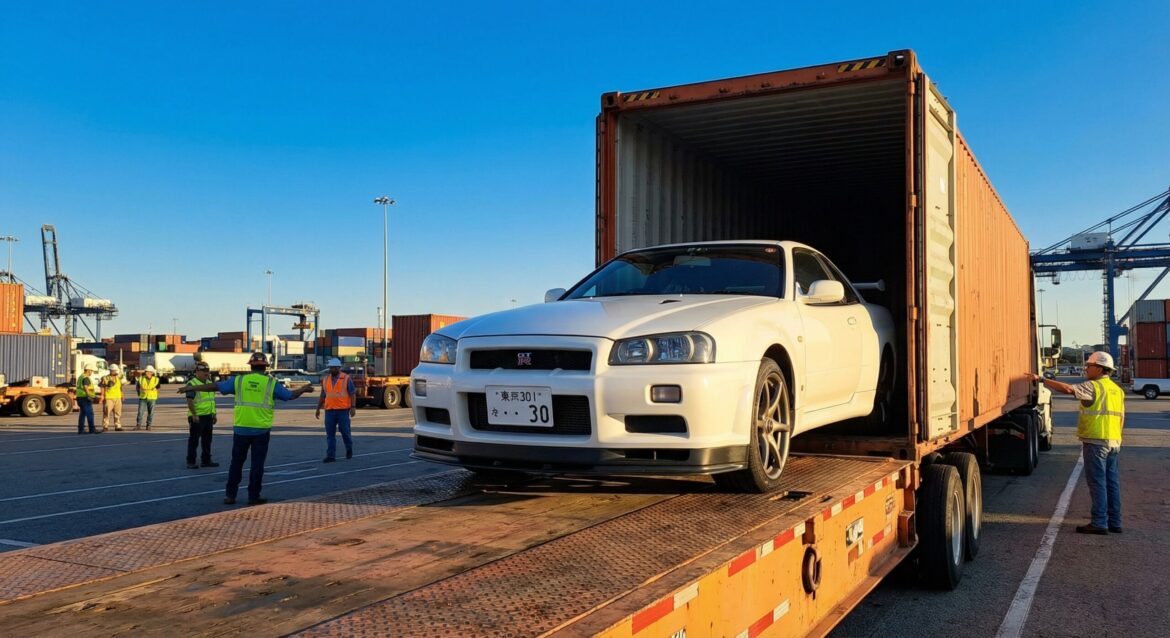
Nissan Skyline R34 GT-R — The most wanted JDM car in America. The V-Spec II was produced through 2002, but earlier production R34s hit the 25-year mark starting this year. Verify the actual build date, not just the model year.
Toyota MR2 Spyder (SW20 late models and ZZW30 early production) — The ZZW30 (“Spyder”) started production in 1999 in Japan. Early units are now eligible.
Suzuki Jimny (JB23W) — The compact off-roader that’s been illegal to sell new in the US but wildly popular in imports. 2001 models are clearing the threshold.
Honda Integra Type R (DC5 early production) — The DC5 launched in Japan in 2001. Early production units qualify.
Mitsubishi Lancer Evolution VII — The Evo VII ran from 2001-2003 in Japan. 2001 build dates are now eligible.
Subaru Impreza WRX STI (GDB) — The GDB-generation STI (the one with the gold wheels and blobeye face) started production in 2000-2001 in Japan. Early builds are eligible.
One important note on all of these: build date, not model year. Japan doesn’t use model years the same way the US does. A car marketed as a “2001 model” in Japan might have a build plate that shows October 2000 or March 2002. The compliance date is based on when the vehicle was actually manufactured, not its commercial model year designation.
The Import Process, Step by Step
1. Buy the vehicle in Japan. Japanese auction houses (USS, TAA, JU) are the main source. Exporters like Japanese Car Direct or Goo-net Export handle procurement. Budget for purchase price plus Japanese export fees and auction commissions.
2. Export from Japan. The exporter handles deregistration and export certification (shaken cancellation). They’ll provide an export certificate, which is your primary ownership document for US customs purposes.
3. Ocean freight to a US port. Vehicles from Japan typically arrive at ports of entry in Los Angeles/Long Beach, Portland, or Baltimore. Freight cost runs $1,500-$3,000 depending on the vessel service, port destination, and current fuel surcharges. April 2026 is running toward the higher end of that range due to fuel cost increases.
4. US Customs clearance. This is where you need a licensed customs broker. Your broker files the entry with CBP, handles EPA form 3520-1 (the emissions exemption form), and DOT form HS-7 (the safety standards exemption declaration). On HS-7, you’ll select box 2A — the 25-year exemption. CBP will verify the build date against your export certificate and bill of lading.
5. Customs duties. The US duty rate on imported passenger vehicles is 2.5% of the declared customs value. The value should reflect what you actually paid — not a number you made up to reduce the duty. CBP flags undervalued entries and the penalty isn’t worth the few hundred dollars you’d save.
6. Port fees and processing. Budget $200-$500 in miscellaneous port fees beyond the freight itself.
7. Domestic transport to your garage. TGAL handles the full chain — ocean freight from Japan, customs clearance through our sister company AWIS, and domestic delivery to your door.
Common Mistakes That Derail Imports
Buying a vehicle that doesn’t actually qualify. The most common error. Someone lists a “2001 Skyline” but the build plate shows April 2002. The vehicle doesn’t qualify. You find out at customs. The fix is expensive and slow — typically re-exportation or destruction. Always get the export certificate before finalizing purchase, and verify the build date yourself.
Inadequate export documentation. US customs requires a proper Japanese export certificate (the deregistration certificate showing the vehicle was officially removed from Japanese roads). Some grey-market sellers skip this. Don’t let them.
Undervaluing on customs forms. This comes up constantly with enthusiast imports. A car worth $40,000 on the Japanese market doesn’t become a $12,000 car because someone wants to reduce their 2.5% duty bill. CBP has access to auction records and comparable sales data. The duty savings on $28,000 of value would be $700 — the penalty for misdeclaration is far higher.
Not planning for state registration. Clearing federal customs doesn’t mean your state will register the vehicle. California, for example, has additional emissions requirements that affect some imports even under the federal 25-year exemption. Check your state’s DMV rules before you buy.
The Domestic Leg: Port to Your Door
Once your JDM vehicle clears customs, it needs to get from the port to you. That’s standard auto transport — and that’s what TGAL handles. We move vehicles from every major US port of entry to any address in the country.
Most JDM imports arrive in Los Angeles/Long Beach, Portland, or Baltimore. From LA to Dallas, that’s about $600-$900. From Baltimore to Chicago, $400-$700. Routes, timing, and current fuel costs affect the final number — get a quote when you’re ready.
Get a quote for your JDM import at get a quote for your JDM import or call (817) 354-8313.
Aldo Flores
Founder & CEO, Trans Global Auto Logistics
Licensed NVOCC • FMC Regulated • 30+ Years in International Vehicle Logistics
Aldo Flores is the CEO of Trans Global Auto Logistics, a licensed NVOCC and FMC-regulated freight forwarder based in Arlington, Texas. With 23 years at TGAL and a lifetime in the family business, Aldo has overseen the shipping of more than 100,000 vehicles worldwide — from military PCS moves and classic cars to commercial fleet exports and boat shipments. TGAL was founded by his mother over 25 years ago, and under Aldo's leadership it has grown into one of the most trusted names in overseas vehicle transport.