Published: July 24, 2026
Washington can be a good destination for a 25-year-old JDM import. Seattle/Tacoma port access, a strong Pacific Northwest enthusiast market, and military buyers around Joint Base Lewis-McChord all make the state a natural landing point for Skylines, Land Cruisers, Delicas, kei trucks, and other right-hand-drive vehicles.
But Washington is not a “Customs cleared, plates tomorrow” state. The shipping plan and the registration plan need to be built together before the vehicle leaves Japan.
TGAL handles the international vehicle shipping side: ocean transport, arrival timing, port release coordination, and inland transport after Customs release. The part buyers sometimes underestimate is what happens next. Washington Department of Licensing title work can stall if the Customs packet, Japanese ownership documents, chassis number, title application, use-tax support, and plate choice do not line up.
This is the planning work to do before booking ocean freight.
Federal import eligibility comes first, but it is not the finish line
A JDM vehicle that is at least 25 years old may qualify for the federal NHTSA exemption from current Federal Motor Vehicle Safety Standards. That gets the vehicle through the federal import gate when the EPA/DOT basis and Customs entry are handled correctly.
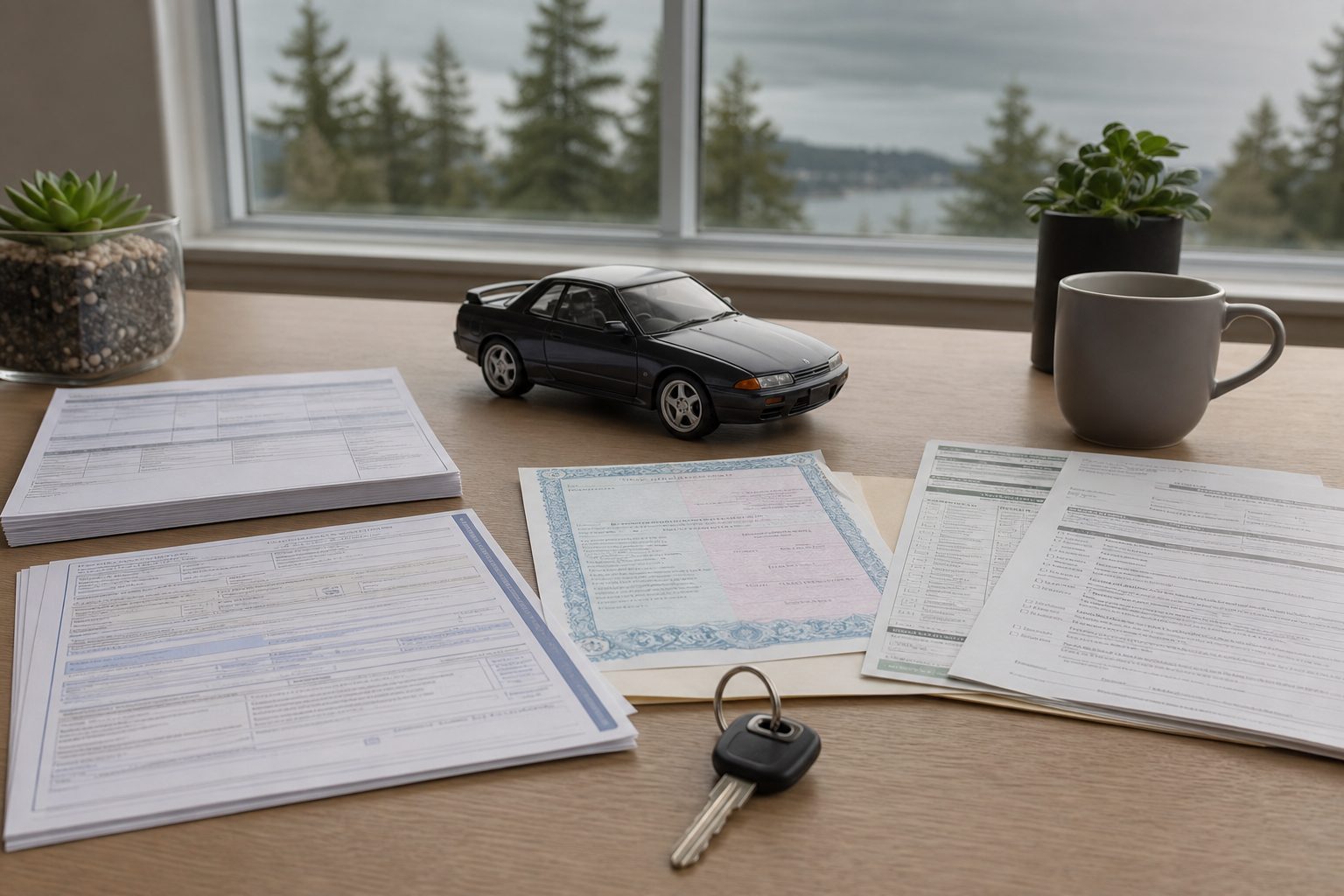
Washington title and registration is separate.
CBP says importers need the carrier’s bill of lading, bill of sale, foreign registration or ownership documents, EPA Form 3520-1, and DOT Form HS-7 for Customs clearance. Washington DOL separately says an imported vehicle must have U.S. Customs or Department of Defense documents that include the year, make, and VIN. DOL’s Customs inspection guidance also says those documents must come from U.S. Customs, not a brokerage or foreign customs office.
That matters for shipping. If the ocean transport is booked before the document packet is clean, the vehicle can arrive in the U.S. before the buyer knows whether Washington will accept the paperwork. That is how a good car turns into a storage invoice with wheels.
If you need help with the Customs clearance/import-entry side, AWIS covers that work here: https://awis.us/jdm-registration-washington-imported-vehicles/
Build the Washington packet before the vessel sails
For a Washington-bound JDM import, do not wait until the car arrives to start the state paperwork review. Build the shipping, Customs, and DOL packet at the same time.
A practical file should include:
- Japanese export certificate or other foreign ownership document
- Certified English translation when the ownership document is not in English
- Bill of sale or purchase invoice
- Bill of lading or arrival notice
- CBP Form 7501 Entry Summary or other Customs release/entry evidence
- EPA Form 3520-1
- DOT Form HS-7
- Any bond release document if the vehicle was entered under bond
- Washington Vehicle Title Application
- Odometer disclosure or odometer-exemption support, if applicable
- Proof of Washington address and owner identification
- Weight documentation if the scale weight is not shown on the ownership record
- Value support for Washington use tax
- Clear photos of the chassis number/VIN location on the vehicle
Washington’s vehicle title application instructions ask for details such as VIN, model year, fuel type, use class, make, body type, scale weight, mileage, owner information, and signatures. For JDM vehicles, the scale weight, mileage, and chassis number fields are the usual friction points.
Before booking ocean transport, call the Washington vehicle licensing office that will process the title. Ask what they want for imported vehicles, whether they need originals or copies, how they handle Japanese chassis numbers, and whether they expect any additional inspection review.
The chassis number needs to stay consistent
Many Japanese-market vehicles do not have a U.S.-style 17-digit VIN. They may have a shorter chassis number such as a frame code plus serial number. That is common. It still has to be handled carefully.
The chassis number should match across the Japanese export certificate, translation, bill of sale, bill of lading, CBP entry, EPA form, DOT form, title application, and the physical vehicle.
Small formatting differences can create real delays. If one document shows BNR32-123456, another shows BNR32123456, and the title application drops a digit, Washington may ask for more review before issuing title.
Before the vehicle leaves Japan:
- Confirm where the chassis number is stamped on the vehicle.
- Get clear photos of the stamp, plate, or firewall marking.
- Compare it to the export certificate and sale documents.
- Decide one consistent format for the shipping and Customs paperwork.
- Flag any mismatch before the vehicle is loaded.
That is boring paperwork. Boring paperwork is cheaper than port storage.
Shipping timing: ocean freight, Customs release, inland delivery, then title work
The clean sequence for a Washington JDM import usually looks like this:
- Confirm federal import eligibility, destination-state requirements, and document readiness before purchase or booking.
- Book ocean transport once the ownership, chassis number, and import basis are clear.
- Prepare Customs entry documents before arrival, not after the vessel is already at port.
- Clear CBP at the first U.S. port of entry or through the planned in-bond routing.
- Release the vehicle from the port, terminal, CFS, or bonded location.
- Arrange inland transport to the Washington destination or inspection/title location.
- Complete Washington title, use tax, registration, plate selection, and any requested inspection review.
The weak link is usually between steps 4 and 7. A vehicle can be physically released and still not be ready for plates because the state packet is incomplete.
TGAL can coordinate the ocean and inland transport timing so the vehicle is not sitting while the buyer scrambles for documents that should have been gathered in Japan.
Washington emissions rules are usually less painful for older JDM imports
Washington’s emissions testing program ended January 1, 2020. The Washington Department of Ecology says vehicle owners are no longer required to have emissions tested before renewing registration.
That is good news for many older JDM buyers, but it is not a free pass on every emissions-related issue.
Washington’s Clean Car Law applies to certain 2009 and newer vehicles. DOL guidance says 2009 and newer cars, light-duty trucks, SUVs, and passenger vans must meet California emission standards to be registered, leased, rented, licensed, or sold for use in Washington, unless an exemption applies. DOL also lists 2008 or earlier model vehicles as exempt from that Clean Car Law requirement.
Most 25-year-old JDM imports arriving in 2026 will be older than 2009, so the Clean Car Law usually should not be the main problem. Still, confirm the rule for the exact vehicle. Fuel type, model year, missing labels, modifications, and local interpretation can still create questions.
Collector Vehicle plates are 30 years, not 25
This is the Washington caveat JDM buyers need to catch early.
The federal 25-year import rule and Washington Collector Vehicle plate age are not the same thing. Washington DOL says Collector Vehicle plates are available for vehicles and trailers 30 years or older.
So a 1999 vehicle imported in 2026 may be federally eligible, but it may not qualify for Washington Collector Vehicle plates yet.
For vehicles that do qualify, collector plates also have use limits. DOL says the vehicle must be owned and operated as a collector vehicle, be in good running order, have insurance, and the owner must have proof of ownership and current registration for a second vehicle used for daily driving, commuting, or business. Collector plates are not for regular transportation, commercial use, or carrying a load.
If the buyer wants a daily driver, plan around standard registration unless the licensing office confirms another path fits.
Use tax and value support can slow the counter visit
Washington use tax is based on the vehicle or vessel’s fair market value. DOL says use tax includes the 0.3% motor vehicle sales and use tax plus the sales tax rate at the buyer’s address.
JDM imports can be harder to value because a Japanese auction price, overseas invoice, repair estimate, or enthusiast-market value may not map cleanly to Washington’s normal vehicle valuation tools.
Bring support:
- Purchase invoice or bill of sale
- Japanese auction sheet, if available
- Export certificate and translation
- Photos showing condition
- Repair estimates, if the vehicle needs work
- Comparable sale records, if value may be questioned
- Customs entry value documents
Do not assume the licensing office will accept a low invoice without context. If the value looks unusual, have the backup ready.
What Washington buyers should confirm before booking ocean transport
Before the vehicle is loaded overseas, confirm:
- The vehicle is federally eligible under the 25-year rule or another valid import path
- The Japanese ownership document is clean and can be translated
- The chassis number is readable and matches the paperwork
- The bill of lading will show the vehicle details consistently
- The Customs broker has the documents needed for entry
- Washington DOL or the local vehicle licensing office has confirmed the imported-vehicle title expectations
- Emissions/Clean Car Law issues do not apply, or an exemption is clear
- The buyer understands standard plates versus Collector Vehicle plate limits
- Use-tax value support is ready
- Inland transport timing does not assume same-day title or plates after Customs release
That last point is important. The vehicle may need to move from the port before it can legally be driven. Plan transport accordingly.
Bottom line for Washington JDM imports
Washington is generally workable for 25-year-old JDM vehicles, but the handoff matters. The buyer needs a shipping plan, a Customs plan, and a Washington title plan before the vehicle leaves Japan.
TGAL can help plan the international vehicle shipping, ocean freight, arrival coordination, and inland transport side so the logistics timing matches the paperwork reality. For Customs clearance and import-entry help, AWIS can handle that side: https://awis.us/jdm-registration-washington-imported-vehicles/
For Washington title, registration, emissions, use tax, inspections, and plate decisions, confirm requirements directly with Washington DOL, the correct vehicle licensing office, Washington Ecology where emissions questions apply, and Washington State Patrol if a VIN inspection is required.
State DMV rules can change, county/licensing-office practices can vary, and requirements may depend on model year, vehicle classification, owner status, documentation, and intended use. This article is general information, not legal advice. Confirm the current requirements with state and county authorities before buying or shipping the vehicle.
Sources reviewed
- Washington State Department of Licensing, Customs inspections: https://dol.wa.gov/vehicles-and-boats/vehicles/vehicle-registration/vehicle-title/customs-inspections
- Washington State Department of Licensing, Vehicle title application instructions: https://dol.wa.gov/vehicles-and-boats/vehicles/buying-and-selling-vehicle/buy-and-register-vehicle/vehicle-title-application-instructions
- Washington State Department of Licensing, Clean Car Law emission requirements: https://dol.wa.gov/vehicles-and-boats/vehicles/buying-and-selling-vehicle/clean-car-law-emission-requirements
- Washington State Department of Licensing, Collector Vehicle specialty design plate: https://dol.wa.gov/vehicles-and-boats/license-plates/get-custom-plates/special-design-plates/collector-vehicle
- Washington State Department of Licensing, Use tax: https://dol.wa.gov/vehicles-and-boats/vehicles/taxes-and-fees/use-tax
- Washington Department of Ecology, Emissions check ends: https://ecology.wa.gov/air-climate/air-quality/vehicle-emissions/emissions-check-ends
- Washington State Patrol, Schedule a VIN inspection: https://wsp.wa.gov/driver/schedule-a-vin/
- U.S. Customs and Border Protection, Importing a Motor Vehicle: https://www.cbp.gov/trade/basic-import-export/importing-car
Aldo Flores
Founder & CEO, Trans Global Auto Logistics
Licensed NVOCC • FMC Regulated • 30+ Years in International Vehicle Logistics
Aldo Flores is the CEO of Trans Global Auto Logistics, a licensed NVOCC and FMC-regulated freight forwarder based in Arlington, Texas. With 23 years at TGAL and a lifetime in the family business, Aldo has overseen the shipping of more than 100,000 vehicles worldwide — from military PCS moves and classic cars to commercial fleet exports and boat shipments. TGAL was founded by his mother over 25 years ago, and under Aldo's leadership it has grown into one of the most trusted names in overseas vehicle transport.