Last Updated: July 13, 2026 | Originally Published: July 12, 2026
Shipping a car overseas is one thing. Shipping an RV, motorhome, fifth wheel, camper, or travel trailer is a different animal.
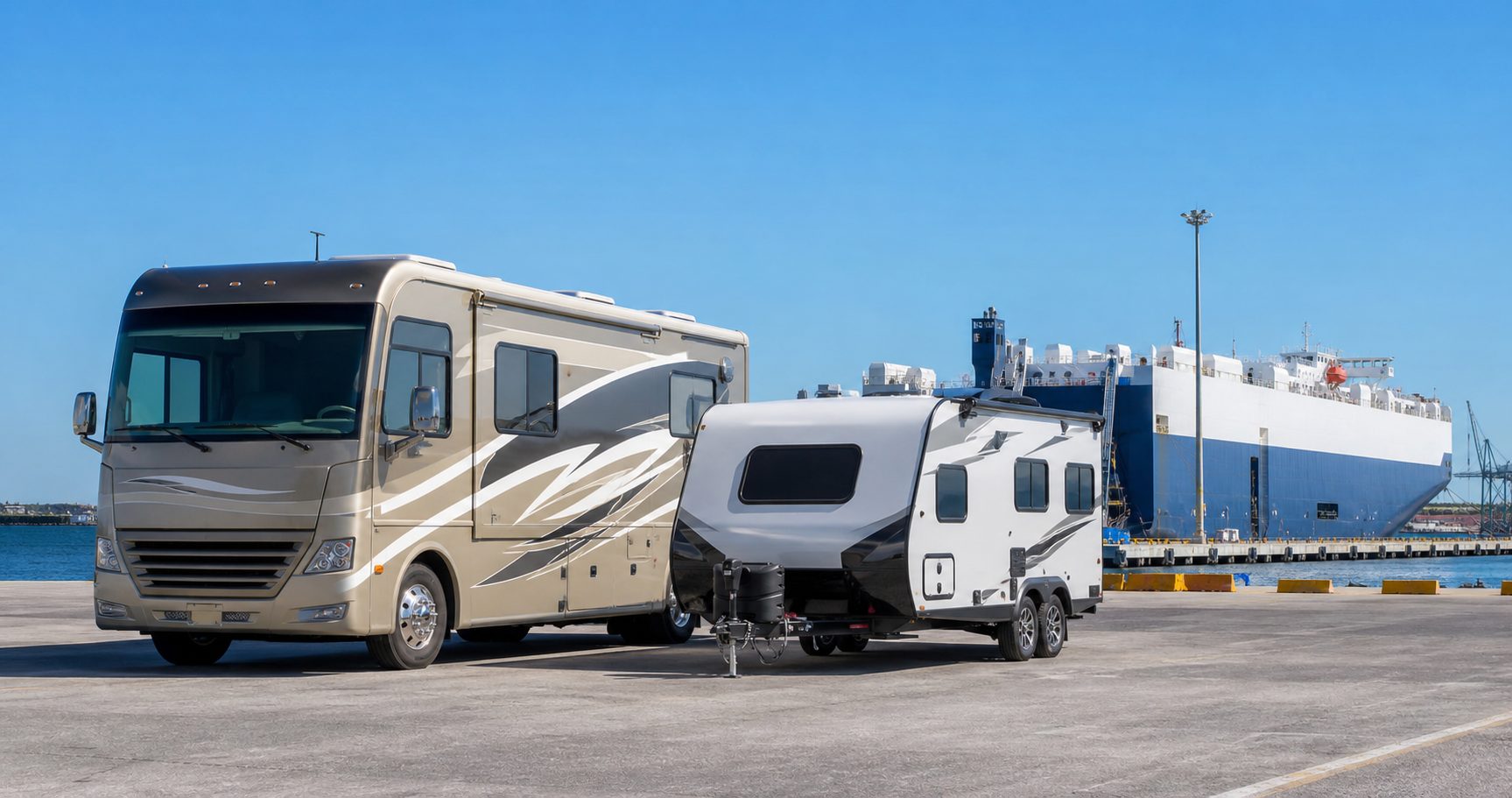
The mistake customers make is assuming the quote works like a normal vehicle shipment with a bigger price tag. Sometimes it does. Often it does not.
RV and travel trailer shipping costs are shaped by dimensions, weight, carrier equipment, port handling, cleaning rules, destination restrictions, marine insurance, inland trucking, storage, and small accessorial charges that do not look small once they stack up.
For military families, this matters even more. A government PCS move may cover one POV under the applicable program, but a privately owned RV, camper, second vehicle, or oversized trailer usually needs its own private shipping plan. The right answer depends on the unit, the route, the port, and the destination country.
Here are the cost factors customers miss before shipping an RV or travel trailer overseas.
Dimensions drive the quote before anything else
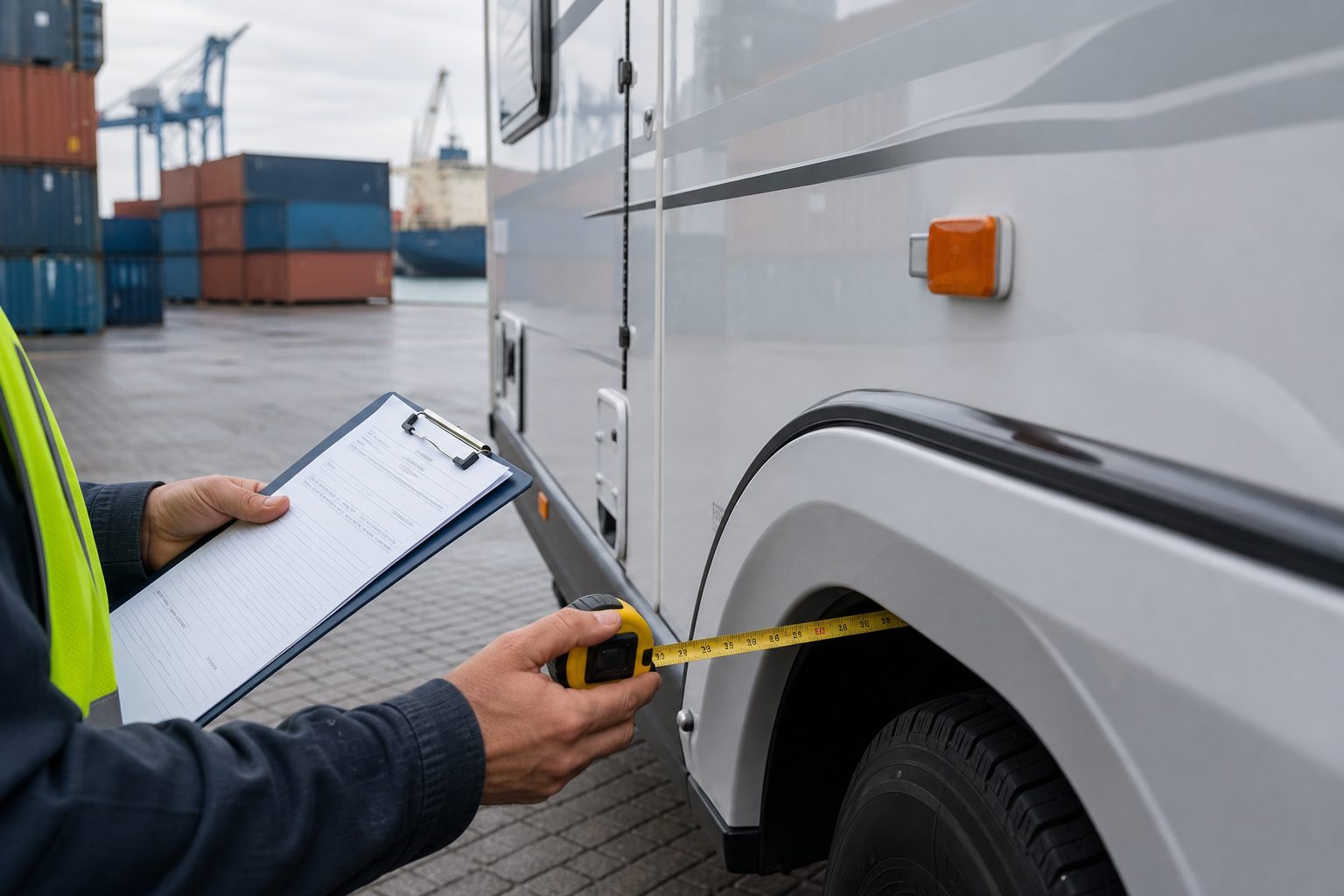
For standard cars, the rate often starts with the lane and vehicle type. For RVs and trailers, the quote starts with the measurements.
A carrier needs accurate:
- Overall length
- Width, including mirrors, awnings, ladder racks, and slide-outs
- Height from ground to highest fixed point
- Weight
- Ground clearance
- Hitch type, if it is a trailer
- Whether the unit runs, steers, brakes, and rolls safely
Do not rely only on the brochure spec. Factory dimensions may not include rooftop air conditioners, solar panels, satellite domes, bike racks, spare tire mounts, ladders, aftermarket lifts, or cargo boxes.
One extra foot can change the rate. One extra inch of height can change the loading method. A few inches of width can turn a normal move into an oversized handling problem.
That is where the quote can jump.
RoRo is often best, but not always available
RoRo, or roll-on/roll-off, is often the cleanest way to ship a motorhome overseas. The RV is driven onto the vessel, secured on deck, and driven off at destination.
For travel trailers and fifth wheels, RoRo may still be possible if the carrier and port can safely tow the unit on and off the vessel. That depends on the trailer condition, hitch setup, tires, brakes, weight, and port equipment.
RoRo can be the best fit when:
- The RV is self-propelled and operational
- The trailer rolls, brakes, and tows safely
- The route has RoRo service for oversized units
- The destination port accepts that cargo type
- The unit does not require container protection
But RoRo is not guaranteed. Some lanes do not have frequent RoRo sailings. Some carriers limit dimensions. Some ports will not accept certain trailers or non-running units. A unit that looks easy in a driveway may be a bad fit for a vessel ramp.
Container shipping has hard limits
A standard container is not a magic box for every RV problem.
Many RVs and travel trailers are too tall, too wide, or too long for a standard 20-foot or 40-foot container. Even if the overall length looks close, door height and internal width may stop the shipment.
Containers may work for smaller campers, compact trailers, parts, accessories, or certain modified units. But for most full-size RVs and travel trailers, container shipping is either impossible or requires special handling.
That can lead to flat rack or open-top options.
Flat rack shipping can work, but it adds cost
A flat rack is used when cargo cannot fit inside a standard container. The RV or trailer may be loaded onto the rack, secured, and moved as out-of-gauge cargo.
That sounds simple. It is not simple.
Flat rack moves can add:
- Special loading and lifting charges
- Crane or heavy forklift handling
- Blocking, bracing, and lashing
- Oversized cargo surcharges
- Higher terminal handling
- More limited sailing options
- More exposure to weather than an enclosed container
Flat rack shipping can solve the feasibility problem, but it usually does not solve the budget problem. It is the ocean freight version of “yes, but bring a bigger checkbook.”
Port handling is different for oversized units
Ports are built for volume, not special favors.
An oversized RV or travel trailer may need extra handling at origin, destination, or both. That can include escort movement inside the terminal, special storage location, tow equipment, forklift support, ramp coordination, or labor outside the normal vehicle process.
Destination ports may also charge differently for oversized cargo. Some calculate handling by unit. Others use cubic meters, weight, equipment type, or labor time.
Customers often focus on the ocean rate and miss the port-side charges. Those charges can be a real part of the final landed cost.
Marine insurance should be based on real replacement exposure
Marine insurance is not just a checkbox.
RVs and travel trailers may carry a higher declared value than a standard used car, and they may include fixtures, appliances, electronics, solar equipment, custom interiors, or attached accessories. The insured value should reflect the actual exposure, not just what the customer paid years ago.
Customers should confirm:
- What value is being insured
- Whether attached accessories are included
- Whether personal items are excluded
- What deductible applies
- What photos or condition records are needed
- Whether damage during inland trucking, port handling, or ocean transit is covered
Personal belongings are a separate issue. Many ocean carriers do not allow personal goods inside vehicles or RVs, and insurance may not cover them. If the customer loads household items inside a camper and something is missing or damaged, that can become a very expensive misunderstanding.
Destination restrictions can stop the move after the quote
Every destination country has its own rules.
Before an RV or travel trailer ships, customers should confirm import eligibility, age restrictions, emissions rules, roadworthiness standards, title or registration requirements, customs duties, VAT or GST, and whether right-hand-drive or left-hand-drive rules matter.
Some destinations also have restrictions around modified vehicles, propane systems, batteries, wood materials, pest contamination, and camping equipment.
A shipping quote does not mean the destination country will allow the unit to clear, register, or drive. That is the part customers miss. The vessel can move cargo. Customs and local authorities decide what happens when it arrives.
Cleaning and biosecurity can be a major cost
RVs and travel trailers are magnets for dirt, seeds, insects, food residue, grass, mud, pet hair, and camping debris.
That matters for countries with strict biosecurity rules. Australia, New Zealand, and other destinations can require vehicles and machinery to arrive free of soil, seeds, plant material, animal material, and other biosecurity risk material. If the unit fails inspection, the customer may face cleaning, inspection, treatment, storage, delay, or re-export costs.
The underside matters. Wheel wells matter. Storage compartments matter. Slide-out tracks, awning housings, steps, hitch areas, spare tire mounts, roof seams, and exterior compartments can all hide contamination.
For RVs and campers, cleaning is not “run it through a car wash.” It may mean a detailed interior and exterior clean before delivery to port, with photos and receipts kept in the file.
Propane, batteries, fuel, and water systems need prep
Carriers and ports have safety rules. Customers should never assume they can ship an RV exactly as it sits at home.
Common preparation items include:
- Propane cylinders removed, emptied, disconnected, or secured according to carrier rules
- Fuel reduced to the required level for the route and carrier
- House batteries declared, disconnected, isolated, or documented where required
- Lithium batteries reviewed before booking
- Water tanks drained
- Waste tanks emptied and cleaned
- Refrigerators cleaned and left odor-free
- Awnings secured
- Slide-outs locked
- Loose exterior items removed
- Keys provided for port handling
Rules vary by carrier, route, and cargo type. The safest approach is to confirm the prep list before the RV leaves the customer’s driveway, not after it reaches the port.
Documents are not the same for every RV or trailer
Documentation depends on what is being shipped and where it is going.
A self-propelled motorhome is treated differently than a non-motorized travel trailer. U.S. export rules for used self-propelled vehicles include title review requirements, and CBP identifies motor homes as self-propelled vehicles under its export vehicle rules. Travel trailers may still require title, registration, bill of sale, lien release, or other ownership documents depending on the carrier, port, destination, and finance status.
Common documents may include:
- Original title or ownership document
- Lienholder authorization, if financed
- Bill of sale or commercial invoice
- Passport or ID copy
- Power of attorney
- Booking forms
- Export documents, including AES or EEI filing when required
- Destination customs documents
- Marine insurance application
- Photos and condition report
If a lien is on the title, do not wait until port cutoff to ask the lender for an export letter. That is how a shipment misses the boat while everyone watches email like it owes them money.
Inland trucking can be harder than ocean freight
Getting the RV or trailer to the port can be one of the biggest cost factors.
A standard car can usually move on an open carrier. An RV or travel trailer may need driveaway service, towaway service, a lowboy, step deck, flatbed, or specialized equipment. The right inland method depends on size, condition, route, and pickup access.
Customers should think about:
- Can a truck safely access the pickup location?
- Is the unit roadworthy?
- Are the tires, brakes, lights, and hitch safe?
- Does the driver need special permits?
- Is the route affected by height or weight limits?
- Can the port receive the unit on the planned date?
Inland cost can surprise customers because it is not just mileage. Oversize permits, escort needs, rural pickup, non-running condition, poor access, and timing can all change the price.
Storage and timing can quietly eat the budget
RV shipping involves several timing points: inland pickup, port receiving, documentation cutoff, vessel cutoff, sailing date, arrival date, customs clearance, destination release, and final pickup.
If the unit arrives too early, storage may start before the vessel accepts cargo. If documents are late, the unit may sit. If the customer cannot pick up at destination, storage may start there too.
Military families should pay special attention here. Report dates, housing availability, temporary lodging, school schedules, and spouse travel plans do not always line up with vessel schedules. Build in storage and timing buffers before the move gets tight.
Accessorial charges are where budgets get bruised
The ocean rate is not the whole landed cost.
Possible accessorial charges include:
- Documentation fees
- AES or export filing charges
- Terminal handling charges
- Port security fees
- Destination handling
- Customs clearance
- Duties and taxes
- Marine insurance
- Cleaning or treatment
- Storage
- Waiting time
- Tow service
- Oversize handling
- Re-delivery
- Inspection fees
None of those should be a mystery. A good quote should separate what is included, what is estimated, and what may be charged by third parties at destination.
What to send before asking for a quote
The fastest way to get a realistic RV or trailer quote is to send the right details up front.
TGAL usually needs:
- Year, make, model, and VIN
- Exact dimensions and weight
- Photos from all four sides
- Photo of the data plate, if available
- Origin ZIP code or city
- Destination country and preferred port
- Running/towing condition
- Title and lien status
- Desired shipping timeline
- Whether personal items are inside
- Any modifications, rooftop equipment, solar, lifts, racks, or added cargo boxes
With RVs and trailers, guessing saves no time. Accurate specs protect the quote, the booking, and the port plan.
The bottom line
The most common missed cost factor is size. Dimensions and weight decide whether the unit can move by RoRo, needs special handling, or requires flat rack service. After that, port handling, cleaning, insurance, inland trucking, documents, storage, and destination rules can all change the final cost.
TGAL helps individual shippers and military relocation customers plan the full move before the RV or travel trailer reaches the port. That means checking feasibility, carrier options, documents, prep requirements, insurance, and destination issues early enough to avoid expensive surprises.
If you are shipping an RV, motorhome, camper, fifth wheel, or travel trailer overseas, start with the specs. The quote is only as good as the measurements behind it.
Aldo Flores
Founder & CEO, Trans Global Auto Logistics
Licensed NVOCC • FMC Regulated • 30+ Years in International Vehicle Logistics
Aldo Flores is the CEO of Trans Global Auto Logistics, a licensed NVOCC and FMC-regulated freight forwarder based in Arlington, Texas. With 23 years at TGAL and a lifetime in the family business, Aldo has overseen the shipping of more than 100,000 vehicles worldwide — from military PCS moves and classic cars to commercial fleet exports and boat shipments. TGAL was founded by his mother over 25 years ago, and under Aldo's leadership it has grown into one of the most trusted names in overseas vehicle transport.