Published: August 14, 2026
Importing a JDM vehicle into New Jersey is not just an ocean freight move. The shipping plan has to line up with how New Jersey MVC handles foreign titles, registration, inspection, tax, insurance, and plate choices after Customs release.
That matters before the vehicle leaves Japan. Once the car is on the water, the buyer has less room to fix mismatched chassis numbers, missing export documents, weak translations, or a DMV packet that should have been confirmed weeks earlier.
TGAL can coordinate the international vehicle shipping side: origin planning, ocean transport, port timing, and inland delivery after release. For Customs clearance and import-entry work, we also recommend involving AWIS early: AWIS New Jersey JDM registration and imported vehicle guidance.
Here is the practical New Jersey planning path for a federally legal JDM import.
Start with the destination-state title process
New Jersey has a state-specific wrinkle that JDM buyers should not ignore: MVC says foreign vehicle title requests must go through the central MVC office. Local MVC agencies cannot issue that type of transfer.
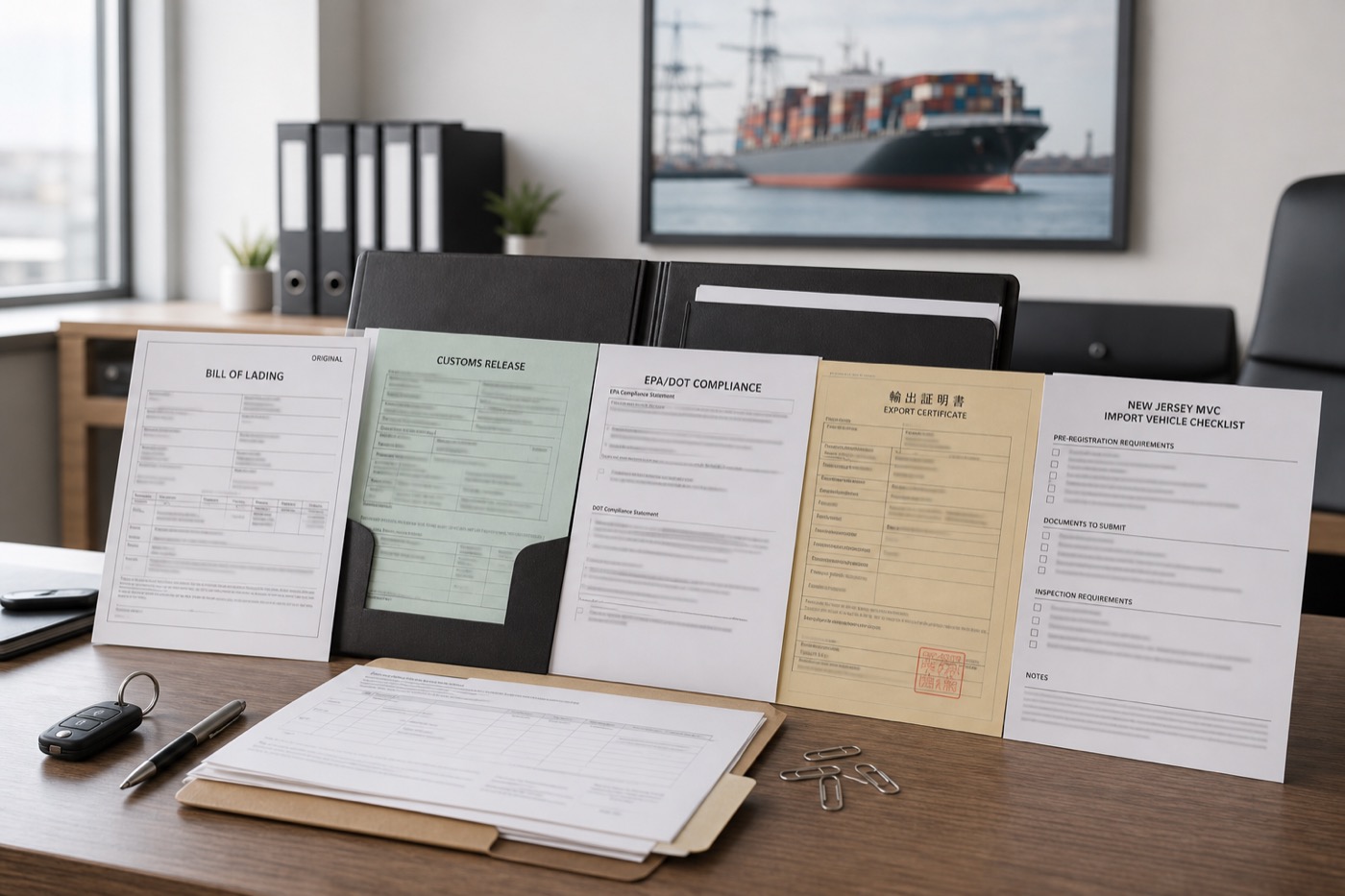
MVC also says a foreign vehicle must be titled in New Jersey before it can be registered. Once the New Jersey title is issued, the owner can visit an MVC agency for registration.
That changes the timing. If the car arrives at the port, clears Customs, and gets delivered inland before the buyer has confirmed the central MVC title packet, the vehicle may sit while paperwork gets sorted. Nobody buys a Skyline so it can become driveway sculpture.
Before booking ocean transport, New Jersey buyers should confirm the current foreign-title requirements with MVC and build the file around that process.
Build the shipping file and MVC file together
For a JDM vehicle shipping from Japan or another overseas market, the same identity details move through several hands:
- Exporter or seller
- Ocean carrier or NVOCC
- Customs broker
- CBP entry process
- Inland carrier
- Insurance provider
- New Jersey MVC
The chassis number should match across the Japanese export certificate, certified translation, bill of sale, bill of lading, EPA Form 3520-1, DOT Form HS-7, CBP entry/release documents, insurance paperwork, and New Jersey title forms.
Many JDM vehicles do not have a U.S.-style 17-digit VIN. That can be normal. What is not helpful is having the same car shown three different ways across the file.
Before the vehicle is loaded overseas, check prefixes, hyphens, spaces, zeros, and model codes. If the export certificate shows one chassis format and the bill of lading shows another, fix it before sailing if possible.
Have certified translations ready before arrival
New Jersey MVC needs to understand the ownership chain. For many Japanese imports, the Japanese export certificate is one of the key title documents.
If the ownership document is in Japanese, plan for a certified English translation before the MVC title request goes to Trenton. The translation should preserve the details that connect the car to the shipping and Customs file:
- Make and model
- Model year or manufacture date information shown on the foreign document
- Chassis number
- Prior owner, exporter, or deregistration information
- Any title or export status notes
A translation that drops the chassis number or changes the vehicle description can create a delay even when the import itself is legal.
Do not confuse Customs release with New Jersey registration
Federal import eligibility and New Jersey registration approval are two separate gates.
For Customs and federal import purposes, a 25-year-old JDM vehicle may be eligible for import without meeting current FMVSS requirements, assuming the age and paperwork are right. Importers still need the federal entry documents, including EPA and DOT import declarations, plus the bill of lading, purchase documents, and CBP release/entry evidence.
New Jersey MVC then reviews the state title and registration side. That means a clean Customs release does not automatically mean plates are ready.
The cleanest handoff is planned in this order:
- Confirm the vehicle is federally importable before purchase or booking.
- Confirm New Jersey title requirements for a foreign vehicle.
- Make sure the export certificate, translation, invoice, and bill of lading match.
- Arrange ocean freight and Customs clearance.
- Hold the inland delivery plan until release timing is realistic.
- Submit the New Jersey title packet through the correct MVC path.
- Register, insure, inspect, or choose the proper plate path based on MVC rules.
Inspection and emissions rules are not just a 25-year question
New Jersey inspection exemptions are age- and category-specific. MVC lists gasoline-powered passenger vehicles from model year 1995 and older with a GVWR of 8,500 pounds or less as exempt from inspection. MVC also lists historic motor vehicles, approved collector vehicles, motorcycles, 100% electric vehicles, and other categories as exempt.
That does not mean every federally legal 25-year-old JDM car automatically skips inspection.
A 1995 gasoline passenger vehicle may fit the 1995-and-older inspection exemption if the registration class and GVWR line up. A 2001 vehicle imported under the 25-year rule in 2026 is a different question. The federal age rule and New Jersey inspection rules are not the same system.
Before shipping, confirm the likely inspection path based on model year, fuel type, GVWR, registration class, and intended use.
Historic plates can fit some JDM imports, but not daily use
New Jersey historic registration is available for vehicles at least 25 years old. MVC says historic vehicles are for exhibition and educational purposes by the owner, and the vehicle must not be modified from original manufacturer specification. Historic vehicles use QQ plates and are listed as inspection-exempt when properly registered.
That can work for a collector vehicle that is going to shows, club events, or limited exhibition use.
It is a bad fit for a daily driver.
If the buyer plans to commute in the vehicle, use it as regular transportation, or hand it to a family member for normal use, standard registration is usually the more honest path. The plate choice should match how the vehicle will actually be used, not just which route looks easier on paper.
Collector vehicle status is usually not the 25-year JDM answer
New Jersey also has collector vehicle status, but it is easy to mix up with historic registration.
MVC says collector vehicles must be limited production, less than 25 years old, not registered as historic or street rod, driven no more than 3,000 miles per year, and insured as a limited-use collector vehicle.
That “less than 25 years old” requirement is the catch. Most JDM imports entering under the federal 25-year rule are already outside the collector-vehicle-status lane. For those vehicles, buyers are usually choosing between normal registration and historic registration, depending on use.
Plan for tax, title fees, and registration fees
New Jersey registration is not finished when Customs duty is paid.
MVC lists title fees, registration fees, and sales tax payment as part of the registration process. Registration fees can vary by vehicle type, and New Jersey directs applicants to the Division of Taxation for help calculating tax.
For JDM imports, preserve the value trail:
- Purchase invoice or bill of sale
- Auction invoice or auction sheet, if available
- Payment records
- Certified translations where needed
- CBP entry documents showing declared value
- Freight and landed-cost records, if requested
Duty, freight, state sales tax, title fees, and registration fees are separate buckets. Treating them as one pile is how paperwork starts leaking out of the container.
What to confirm before booking ocean transport to New Jersey
Before the vehicle is loaded overseas, a New Jersey JDM buyer should verify:
- The vehicle is old enough and otherwise eligible for U.S. import.
- The seller can provide a clean Japanese export certificate or acceptable ownership document.
- Certified English translations can be prepared before MVC review.
- The chassis number is consistent across every document.
- The bill of lading will identify the vehicle clearly.
- Customs broker instructions include EPA Form 3520-1 and DOT Form HS-7 planning.
- The buyer understands the central MVC foreign-title process.
- New Jersey insurance can be arranged before registration.
- The inspection or exemption path has been checked by model year, fuel type, GVWR, and plate type.
- The buyer is choosing standard or historic plates based on real use.
- Tax and value support will be available for MVC and tax questions.
- Clean scans of every document are saved before originals are mailed.
Common New Jersey delays after arrival
The most common problems are preventable:
- Trying to handle a foreign title at a normal MVC agency first
- Mailing original documents without confirming current MVC requirements
- Missing or weak translation of the Japanese export certificate
- Chassis number mismatch between the export paperwork, bill of lading, and CBP documents
- Missing EPA or DOT import declarations
- Broker worksheets being mistaken for official CBP release/entry evidence
- No New Jersey insurance ready for registration
- Assuming 25 years old means no inspection issue
- Choosing historic plates for a vehicle that will be used regularly
- Confusing collector vehicle status with historic registration
- Incomplete tax/value support
The fix is simple: plan the state registration file at the same time as the shipping file.
TGAL can help with the shipping timeline
A New Jersey JDM import has several timing points:
- Overseas document collection
- Export and port receiving
- Ocean sailing schedule
- U.S. arrival
- Customs entry and release
- Port availability
- Inland transport to New Jersey or nearby storage
- MVC title review
- Registration, insurance, inspection, and plate work
TGAL can help coordinate the international vehicle shipping and delivery side so the move does not outrun the paperwork. AWIS can help with Customs clearance, entry planning, duty, EPA/DOT document coordination, and release support: AWIS New Jersey JDM import guidance.
Bottom line for New Jersey JDM buyers
New Jersey can be workable for a 25-year-old JDM import, but it rewards buyers who prepare early.
The biggest state-specific issue is that foreign vehicle title requests go through New Jersey MVC’s central office before registration. Confirm that process before booking ocean freight, keep the chassis number consistent, prepare certified translations, save official Customs documents, and verify inspection or plate options before the car lands.
This article is general information, not legal or DMV advice. New Jersey MVC, tax, inspection, insurance, county, and plate rules can change, and handling can depend on the vehicle, documents, owner facts, and intended use. Confirm current requirements directly with New Jersey MVC, the New Jersey Division of Taxation, your county/agency contact when applicable, and qualified professionals before buying, shipping, titling, or registering a vehicle.
Sources reviewed
- New Jersey MVC, Foreign Vehicles: https://www.nj.gov/mvc/vehicles/foreign.htm
- New Jersey MVC, Vehicles Exempt From Inspection: https://www.nj.gov/mvc/inspection/exemptinsp.htm
- New Jersey MVC, Historic and Street Rod: https://www.nj.gov/mvc/vehicles/historic.htm
- New Jersey MVC, Collector Vehicles: https://www.nj.gov/mvc/vehicletopics/collectveh.htm
- New Jersey MVC, Vehicle Registration: https://www.nj.gov/mvc/vehicles/reginitial.htm
- U.S. Customs and Border Protection, Importing a Motor Vehicle: https://www.cbp.gov/trade/basic-import-export/importing-car
- NHTSA, Importation and Certification FAQs: https://www.nhtsa.gov/importing-vehicle/importation-and-certification-faqs
- U.S. EPA, Importing Vehicles and Engines: https://www.epa.gov/importing-vehicles-and-engines
Aldo Flores
Founder & CEO, Trans Global Auto Logistics
Licensed NVOCC • FMC Regulated • 30+ Years in International Vehicle Logistics
Aldo Flores is the CEO of Trans Global Auto Logistics, a licensed NVOCC and FMC-regulated freight forwarder based in Arlington, Texas. With 23 years at TGAL and a lifetime in the family business, Aldo has overseen the shipping of more than 100,000 vehicles worldwide — from military PCS moves and classic cars to commercial fleet exports and boat shipments. TGAL was founded by his mother over 25 years ago, and under Aldo's leadership it has grown into one of the most trusted names in overseas vehicle transport.